Pearson+ LogoPearson+ Logo
Ch.10 Proteins Workers of the Cell
Frost - General, Organic and Biological Chemistry 4th Edition
Frost4th EditionGeneral, Organic and Biological ChemistryISBN: 9780134988696Not the one you use?Change textbook
Chapter 6, Problem 93d

If each of the following amino acid side chains is present in the active site of an enzyme, indicate whether it would (a) serve a catalytic function, (b) serve to hold the substrate, or (c) both.
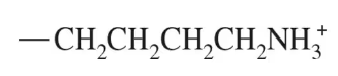
d. lysine
Chemical structure of lysine with a positively charged amino group, relevant to enzyme function in biochemistry.

Verified step by step guidance
1
Identify the structure and properties of the lysine side chain. Lysine is an amino acid with a positively charged amine group (-NH3+) at the end of its side chain, making it a basic amino acid.
Understand the role of lysine in enzyme active sites. The positively charged amine group can interact with negatively charged groups or polar molecules, making it capable of forming ionic bonds or hydrogen bonds.
Determine if lysine can serve a catalytic function. The amine group can participate in acid-base catalysis by donating or accepting protons, which is a common catalytic mechanism in enzymes.
Evaluate if lysine can hold the substrate. The positive charge on lysine's side chain allows it to interact with negatively charged regions of the substrate, helping to stabilize the substrate in the active site.
Conclude that lysine can serve both functions: (a) catalytic function through acid-base catalysis and (b) holding the substrate through ionic or hydrogen bonding interactions.

Verified video answer for a similar problem:

This video solution was recommended by our tutors as helpful for the problem above.
Video duration:
3m
Was this helpful?

Key Concepts

Here are the essential concepts you must grasp in order to answer the question correctly.

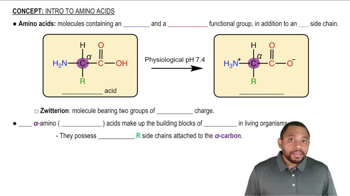
Amino Acid Side Chains

Amino acid side chains, or R groups, determine the chemical properties and functions of amino acids in proteins. They can be polar, nonpolar, acidic, or basic, influencing how they interact with substrates and other molecules. Understanding the nature of these side chains is crucial for predicting their roles in enzyme activity, including catalysis and substrate binding.
Recommended video:
Guided course
3:04
Intro to Amino Acids Concept 1

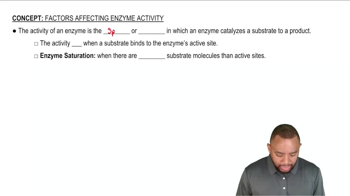
Enzyme Active Site

The active site of an enzyme is a specific region where substrate molecules bind and undergo a chemical reaction. The structure and chemical environment of the active site are tailored to facilitate the conversion of substrates into products. The presence of specific amino acid side chains in this region can enhance catalytic efficiency or stabilize substrate binding.
Recommended video:
Guided course
1:06
Factors Affecting Enzyme Activity Concept 1

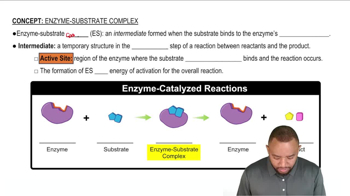
Catalytic Function vs. Substrate Binding

Catalytic function refers to the ability of an enzyme to accelerate a chemical reaction, often involving specific amino acids that participate directly in the reaction mechanism. In contrast, substrate binding involves interactions that hold the substrate in place, which may not necessarily lead to a chemical transformation. Distinguishing between these roles is essential for understanding how different amino acids contribute to enzyme function.
Recommended video:
Guided course
2:32
Enzyme-Substrate Complex Concept 1
Related Practice
Textbook Question

Does each of the following statements describe a simple enzyme (no cofactor or coenzyme necessary), an enzyme that requires a cofactor, or an enzyme that requires a coenzyme?

c. contains vitamin B6 in its active site

Textbook Question

A substrate is held in the active site of an enzyme by attractive forces between the substrate and the amino acid side chains. For the outlined regions A, B, and C on the following substrate molecule:

b. Could the amino acids serine, lysine, or glutamate be present in the active site? Support your answer.

Textbook Question

If each of the following amino acid side chains is present in the active site of an enzyme, indicate whether it would (a) serve a catalytic function, (b) serve to hold the substrate, or (c) both.

a. aspartate

Textbook Question

Pepsin, an enzyme that hydrolyzes peptide bonds in proteins, functions in the stomach at a pH optimum of 1.5 to 2.0. How is the rate of a pepsin-catalyzed reaction affected by each of the following conditions?

a. increasing the concentration of proteins

Textbook Question

Pepsin, an enzyme that hydrolyzes peptide bonds in proteins, functions in the stomach at a pH optimum of 1.5 to 2.0. How is the rate of a pepsin-catalyzed reaction affected by each of the following conditions?

c. running the reaction at 0 °C

Textbook Question

Problems 10.94 and 10.95 both mention enzymes that hydrolyze peptide bonds. How do you account for the fact that pepsin has a high catalytic activity at pH 1.5 but chymotrypsin has very little activity at pH 1.5?