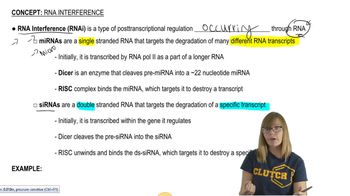
RNAi may be directed by small interfering RNAs (siRNAs) or microRNAs (miRNAs); how are these similar, and how are they different?
Ch. 18 - Post-transcriptional Regulation in Eukaryotes

Chapter 18, Problem 16
Competing endogenous RNAs act as molecular 'sponges.' What does this mean, and what do they compete with?
Verified step by step guidance1
Understand that competing endogenous RNAs (ceRNAs) are RNA molecules that regulate gene expression by binding to microRNAs (miRNAs), which are small non-coding RNAs involved in gene silencing.
Recognize that miRNAs typically bind to messenger RNAs (mRNAs) to inhibit their translation or promote their degradation, thus reducing protein production.
Learn that ceRNAs act as molecular 'sponges' by containing binding sites for specific miRNAs, effectively sequestering these miRNAs and preventing them from binding to their target mRNAs.
Identify that the competition is between ceRNAs and mRNAs for binding to the same pool of miRNAs; by 'soaking up' miRNAs, ceRNAs reduce the miRNA-mediated repression of mRNAs.
Conclude that this mechanism allows ceRNAs to indirectly regulate gene expression by modulating the availability of miRNAs to their target mRNAs.

Verified video answer for a similar problem:
This video solution was recommended by our tutors as helpful for the problem above.
Video duration:
55sWas this helpful?
Key Concepts
Here are the essential concepts you must grasp in order to answer the question correctly.
Competing Endogenous RNAs (ceRNAs)
Competing endogenous RNAs are RNA molecules that regulate gene expression by binding and sequestering microRNAs (miRNAs). By acting as molecular 'sponges,' they reduce the availability of miRNAs to bind their usual target mRNAs, thus influencing the expression of those genes.
Recommended video:
MicroRNAs (miRNAs)
MicroRNAs are small non-coding RNAs that regulate gene expression post-transcriptionally by binding to complementary sequences on target mRNAs, leading to mRNA degradation or translational repression. Their activity is modulated by interactions with ceRNAs.
Recommended video:
Guided course
RNA Interference
Molecular 'Sponge' Mechanism
The 'sponge' mechanism refers to ceRNAs competing with mRNAs for binding to shared miRNAs. By sequestering miRNAs, ceRNAs prevent them from repressing target mRNAs, thereby indirectly increasing the expression of those genes.
Recommended video:
Guided course
Mapping with Markers
Related Practice
Textbook Question
Textbook Question
miRNAs target endogenous mRNAs in a sequence-specific manner. Explain, conceptually, how one might identify potential mRNA targets for a given miRNA if you only know the sequence of the miRNA and the sequence of all mRNAs in a cell or tissue of interest.
Textbook Question
In principle, RNAi may be used to fight viral infection. How might this work?
Textbook Question
While circular RNAs were first described long ago, they have only recently been investigated for function. What are their known and suspected functions in the cell?
Textbook Question
How are mRNAs stored within the cell in a translationally inactive state, and how can their translation be stimulated?
Textbook Question
How and why are eukaryotic mRNAs transported and localized to discrete regions of the cell?
2
views