GeCl4 reacts with Cl- to give GeCl62-, but CCl4 does not react with excess Cl-. Explain.
Ch.22 - The Main Group Elements
Chapter 22, Problem 22.113
Compare and contrast the properties of ammonia and phosphine.
Verified step by step guidance1
Identify the chemical formulas for ammonia and phosphine: Ammonia is NH₃ and phosphine is PH₃.
Compare the molecular geometry: Both ammonia and phosphine have a trigonal pyramidal shape due to the presence of a lone pair on the nitrogen and phosphorus atoms, respectively.
Discuss the polarity: Ammonia is polar due to the difference in electronegativity between nitrogen and hydrogen, while phosphine is less polar because the electronegativity difference between phosphorus and hydrogen is smaller.
Examine the hydrogen bonding: Ammonia can form hydrogen bonds due to the presence of highly electronegative nitrogen, whereas phosphine cannot form hydrogen bonds as effectively because phosphorus is less electronegative.
Compare the boiling points: Ammonia has a higher boiling point than phosphine due to the presence of hydrogen bonding, which requires more energy to break compared to the weaker van der Waals forces in phosphine.

Verified video answer for a similar problem:
This video solution was recommended by our tutors as helpful for the problem above.
Was this helpful?
Key Concepts
Here are the essential concepts you must grasp in order to answer the question correctly.
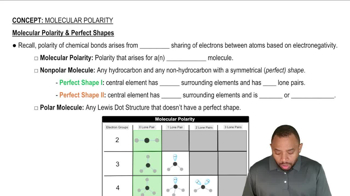
Molecular Structure and Polarity
Ammonia (NH3) and phosphine (PH3) have distinct molecular structures that influence their properties. Ammonia has a trigonal pyramidal shape due to the presence of a lone pair on nitrogen, making it polar and capable of hydrogen bonding. In contrast, phosphine has a similar structure but is less polar due to phosphorus's larger size and lower electronegativity, resulting in weaker intermolecular forces.
Recommended video:
Guided course
Molecular Polarity
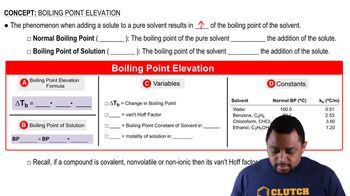
Boiling Points and Volatility
The boiling points of ammonia and phosphine differ significantly due to their molecular interactions. Ammonia has a higher boiling point (−33.34 °C) because of strong hydrogen bonds, while phosphine has a lower boiling point (−87.7 °C) due to weaker van der Waals forces. This difference in boiling points reflects their volatility and stability as gases at room temperature.
Recommended video:
Guided course
Boiling Point Elevation
Reactivity and Chemical Behavior
Ammonia and phosphine exhibit different reactivities due to their molecular characteristics. Ammonia is a strong base and can readily donate a proton, participating in various acid-base reactions. Phosphine, on the other hand, is less basic and more stable, making it less reactive under similar conditions. This difference affects their roles in chemical reactions and their applications in various fields.
Recommended video:
Guided course
Chemical Properties
Related Practice
Textbook Question
Textbook Question
Using the shorthand notation of Figure 22.9, draw the structure of the cyclic silicate anion in which four SiO4 tetrahedra share O atoms to form an eight-membered ring of alternating Si and O atoms. Give the formula and charge of the anion.
Textbook Question
Which of the following elements (X) will form a covalent hydride with the formula XH3 that is a gas at room temperature? (LO 22.4)
(a) Al (b) As (c) Ba (d) Se
Textbook Question
Give an example of an ionic carbide. What is the oxidation state of carbon in this substance?
Textbook Question
Draw the electron-dot structure for CO, CO2, and CO32–, and predict which substance will have the strongest carbon–oxygen bond.
Textbook Question
Arrange the following oxides in order of increasing basic character: Al2O3, Cs2O, K2O, N2O5.