What is a racemic mixture? Does it affect plane-polarized light? Explain.
Ch.21 - Transition Elements and Coordination Chemistry
Chapter 21, Problem 21.39
Predict the number of unpaired electrons for each of the following.
(a) Sc3+
(b) Co2+
Verified step by step guidance1
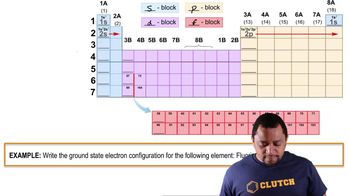
Determine the electron configuration of the neutral atom for each element.
For Scandium (Sc), the atomic number is 21, so the electron configuration is [Ar] 3d^1 4s^2.
For Cobalt (Co), the atomic number is 27, so the electron configuration is [Ar] 3d^7 4s^2.
Remove electrons according to the charge of the ion. For Sc^3+, remove three electrons from the outermost orbitals, resulting in [Ar].
For Co^2+, remove two electrons from the outermost orbitals, resulting in [Ar] 3d^7. Determine the number of unpaired electrons in the 3d subshell.

Verified video answer for a similar problem:
This video solution was recommended by our tutors as helpful for the problem above.
Was this helpful?
Key Concepts
Here are the essential concepts you must grasp in order to answer the question correctly.
Electron Configuration
Electron configuration describes the distribution of electrons in an atom's orbitals. It follows the Aufbau principle, which states that electrons fill lower-energy orbitals first. Understanding the electron configuration of an element is crucial for predicting its chemical behavior, including the number of unpaired electrons.
Recommended video:
Guided course
Electron Configuration Example
Unpaired Electrons
Unpaired electrons are those that occupy an orbital alone, without a partner of opposite spin. The presence of unpaired electrons in an atom influences its magnetic properties and reactivity. Atoms with unpaired electrons are often paramagnetic, while those with all electrons paired are diamagnetic.
Recommended video:
Guided course
Electron Geometry
Transition Metals and Oxidation States
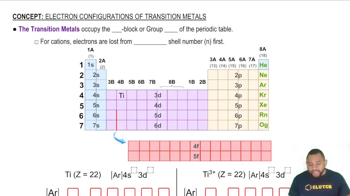
Transition metals can exhibit multiple oxidation states due to their ability to lose different numbers of d electrons. The oxidation state affects the electron configuration and, consequently, the number of unpaired electrons. For example, Scandium (Sc) in the +3 oxidation state loses three electrons, while Cobalt (Co) in the +2 state loses two, altering their electron configurations.
Recommended video:
Guided course
Transition Metals
Related Practice
Textbook Question
Textbook Question
What is the name of the compound [Fe(H2O)5(SCN)]Cl2?
(a) pentaaquathiocyanatoiron(III) chloride
(b) pentaaquachlorothiocyanato iron(III)
(c) pentaaquathiocyanatoiron(III) dichloride
(d) pentaaquathiocyanatoiron(II) chloride
1
views
1
rank
Textbook Question
Which of the following complexes can exist as enantiomers? Draw their structures.
(a) [Cr(en)3]3+
(b) cis-[Co(NH3)Cl]2+
(c) trans-[Co(en)2(NH3)Cl]2+
(d) [Pt(NH3)3Cl3]+
Textbook Question
What is the highest oxidation state for each of the elements from Sc to Zn?
Textbook Question
Based on effective nuclear charge (Zeff), which ion is the strongest oxidizing agent?
(a) Cu2+
(b) Ni2+
(c) Fe2+
(d) Mn2+
Textbook Question
What is the systematic name for each of the following coordination compounds?
(a) Cs[FeCl4]
(b) [V(H2O)6](NO3)3