Classify each of the following ions according to whether they react with water to give a neutral, acidic, or basic solution. (a) F-
Verified step by step guidance
1
Step 1: Identify the ion. In this case, the ion is F-, which is the fluoride ion.
Step 2: Determine if the ion is a conjugate acid or a conjugate base. Since F- is the conjugate base of HF (hydrofluoric acid), it will react with water to form HF and OH-.
Step 3: Understand that the formation of OH- ions will increase the pH of the solution, making it basic.
Step 4: Therefore, F- reacts with water to give a basic solution.
Verified video answer for a similar problem:
This video solution was recommended by our tutors as helpful for the problem above.
Video duration:
1m
Play a video:
0 Comments
Was this helpful?
Key Concepts
Here are the essential concepts you must grasp in order to answer the question correctly.
Acid-Base Theory
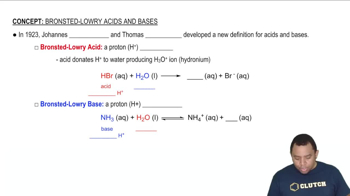
Acid-base theory explains how substances can donate or accept protons (H+ ions). According to the Brønsted-Lowry theory, acids are proton donors, while bases are proton acceptors. This concept is crucial for understanding how ions interact with water to affect the pH of a solution.
Hydrolysis refers to the reaction of an ion with water, leading to the formation of an acid or base. For example, when fluoride ions (F-) react with water, they can accept a proton, forming HF, which is a weak acid. This process determines whether the resulting solution is acidic, basic, or neutral.
The pH scale measures the acidity or basicity of a solution, with values below 7 indicating acidity, above 7 indicating basicity, and 7 being neutral. Understanding how ions like F- affect the concentration of H+ ions in solution is essential for classifying the resulting solution as acidic, basic, or neutral.