Table of contents
- 0. Functions(0)
- Introduction to Functions(0)
- Piecewise Functions(0)
- Properties of Functions(0)
- Common Functions(0)
- Transformations(0)
- Combining Functions(0)
- Exponent rules(0)
- Exponential Functions(0)
- Logarithmic Functions(0)
- Properties of Logarithms(0)
- Exponential & Logarithmic Equations(0)
- Introduction to Trigonometric Functions(0)
- Graphs of Trigonometric Functions(0)
- Trigonometric Identities(0)
- Inverse Trigonometric Functions(0)
- 1. Limits and Continuity(0)
- 2. Intro to Derivatives(0)
- 3. Techniques of Differentiation(0)
- 4. Applications of Derivatives(0)
- 5. Graphical Applications of Derivatives(0)
- 6. Derivatives of Inverse, Exponential, & Logarithmic Functions(0)
- 7. Antiderivatives & Indefinite Integrals(0)
- 8. Definite Integrals(0)
- 9. Graphical Applications of Integrals(0)
- 10. Physics Applications of Integrals (0)
- 11. Integrals of Inverse, Exponential, & Logarithmic Functions(0)
- 12. Techniques of Integration(0)
- 13. Intro to Differential Equations(0)
- 14. Sequences & Series(0)
- 15. Power Series(0)
- 16. Parametric Equations & Polar Coordinates(0)
5. Graphical Applications of Derivatives
Applied Optimization
5. Graphical Applications of Derivatives
Applied Optimization: Videos & Practice Problems
82 of 0
Problem 82Multiple Choice
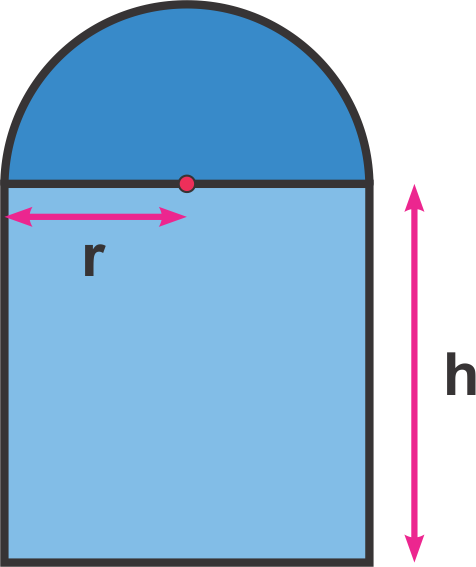
A city park is designing a decorative sign in the shape of a rectangle topped by a semicircle. The rectangular portion is made of clear acrylic, while the semicircular top is made of frosted acrylic, which allows only one-third as much light through per unit area as the clear portion. The total perimeter of the sign is fixed. Let be the radius of the semicircle and be the height of the rectangular portion. Determine the ratio of to that will allow the most light to pass through. Neglect the thickness of the sign.

0 Comments