Table of contents
- 0. Functions(0)
- Introduction to Functions(0)
- Piecewise Functions(0)
- Properties of Functions(0)
- Common Functions(0)
- Transformations(0)
- Combining Functions(0)
- Exponent rules(0)
- Exponential Functions(0)
- Logarithmic Functions(0)
- Properties of Logarithms(0)
- Exponential & Logarithmic Equations(0)
- Introduction to Trigonometric Functions(0)
- Graphs of Trigonometric Functions(0)
- Trigonometric Identities(0)
- Inverse Trigonometric Functions(0)
- 1. Limits and Continuity(0)
- 2. Intro to Derivatives(0)
- 3. Techniques of Differentiation(0)
- 4. Applications of Derivatives(0)
- 5. Graphical Applications of Derivatives(0)
- 6. Derivatives of Inverse, Exponential, & Logarithmic Functions(0)
- 7. Antiderivatives & Indefinite Integrals(0)
- 8. Definite Integrals(0)
- 9. Graphical Applications of Integrals(0)
- 10. Physics Applications of Integrals (0)
- 11. Integrals of Inverse, Exponential, & Logarithmic Functions(0)
- 12. Techniques of Integration(0)
- 13. Intro to Differential Equations(0)
- 14. Sequences & Series(0)
- 15. Power Series(0)
- 16. Parametric Equations & Polar Coordinates(0)
5. Graphical Applications of Derivatives
Applied Optimization
5. Graphical Applications of Derivatives
Applied Optimization: Videos & Practice Problems
81 of 0
Problem 81Multiple Choice
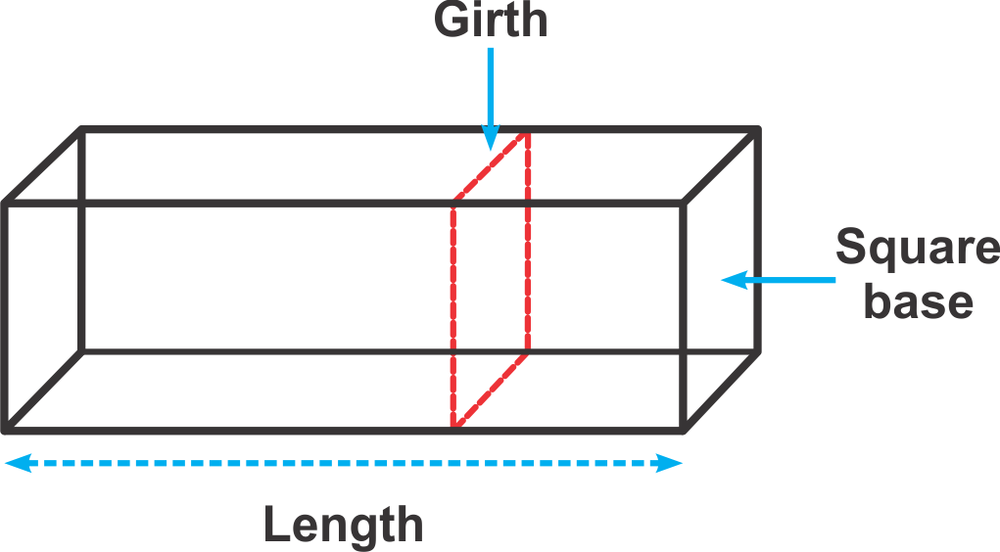
A shipping company is designing a rectangular crate with a square base to maximize volume for domestic delivery. Shipping regulations require that the sum of the length and the girth (the distance around the four sides of the base) must not exceed inches. Let the base have a side length inches, and let the length of the box be inches. Identify the value of that gives the maximum volume.

0 Comments