Pearson+ LogoPearson+ Logo
Ch. 7 - Inside the Cell
Freeman - Biological Science 8th Edition
Freeman8th EditionBiological ScienceISBN: 9780138276263Not the one you use?Change textbook
Chapter 7, Problem 8

The eukaryotic cytoskeleton is a highly dynamic network of filaments and motor proteins. Which of the following correctly describe activities of these cytoskeletal components? Select True or False for each statement.
T/FMyosin motors walk toward the plus ends of intermediate filaments.
T/FDynein motors are responsible for the whip-like movement of eukaryotic flagella.
T/FKinesin motors move vesicles along tracks toward the microtubule-organizing center.
T/FActin filaments are required for cytoplasmic streaming.

Verified step by step guidance
1
Understand the role of myosin motors: Myosin motors are associated with actin filaments, not intermediate filaments. They typically move toward the plus end of actin filaments, facilitating muscle contraction and other cellular movements.
Explore dynein motors: Dynein motors are indeed responsible for the movement of eukaryotic flagella and cilia. They generate force by moving along microtubules, causing the whip-like motion characteristic of flagella.
Examine kinesin motors: Kinesin motors generally move toward the plus end of microtubules, which is typically away from the microtubule-organizing center (MTOC). They are involved in transporting vesicles and organelles within the cell.
Investigate actin filaments: Actin filaments play a crucial role in cytoplasmic streaming, a process that helps distribute nutrients and organelles within cells, particularly in large plant cells.
Review the statements: Based on the understanding of each motor protein and filament, evaluate the truthfulness of each statement regarding their activities and functions within the cytoskeleton.

Verified video answer for a similar problem:

This video solution was recommended by our tutors as helpful for the problem above.
Video duration:
1m
Was this helpful?

Key Concepts

Here are the essential concepts you must grasp in order to answer the question correctly.

Cytoskeleton Structure and Function

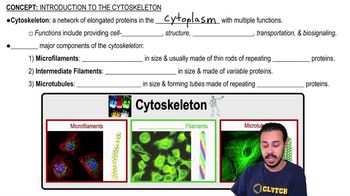
The eukaryotic cytoskeleton is a complex network of protein filaments that provides structural support, facilitates intracellular transport, and enables cell movement. It consists of microtubules, actin filaments, and intermediate filaments, each with distinct roles and properties. Understanding the cytoskeleton's dynamic nature is crucial for comprehending cellular processes like division, signaling, and motility.
Recommended video:
Guided course
06:05
Introduction to the Cytoskeleton

Motor Proteins

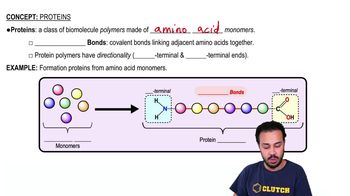
Motor proteins are specialized molecules that convert chemical energy into mechanical work, enabling movement along cytoskeletal filaments. Key motor proteins include myosin, kinesin, and dynein, each with specific directional movement and functions. Myosin typically interacts with actin filaments, while kinesin and dynein move along microtubules, facilitating transport of organelles and vesicles within cells.
Recommended video:

Microtubule and Actin Filament Dynamics

Microtubules and actin filaments are dynamic structures that undergo rapid polymerization and depolymerization, allowing cells to adapt and change shape. Microtubules are involved in organizing cellular components and facilitating transport, while actin filaments are crucial for cell movement and shape changes. Their dynamic nature is essential for processes like cytoplasmic streaming, which involves the movement of cytoplasm within cells to distribute nutrients and organelles.
Recommended video:
Guided course
03:37
Disturbances Make Communities Dynamic
Related Practice
Textbook Question

Which of the following cell structures would you expect to be most important in the growth of bacteria on the surface of your teeth?

a. Cell wall

b. Fimbriae

c. Flagella

d. Cilia

1
views
Textbook Question

Cells that line your intestines are known to possess a large number of membrane proteins that transport small molecules and ions across the plasma membrane. Which of the following cell structures would you expect to be required for this characteristic of the cells?

a. The endoplasmic reticulum

b. Peroxisomes

c. Lysosomes

d. The cell wall

Textbook Question

Most of the proteins that enter the nucleus possess a nuclear localization signal (NLS), even if they are small enough to pass through the nuclear pore complex unhindered. Why would a small protein have an NLS, when it naturally diffuses across the nuclear pore complex without one?

4
views
Textbook Question

When analyzing a sample of cells from a patient, you find the lysosomes are filled with undigested material. This observation makes you think that the lysosomes are not functioning properly. What are three different defects that could be responsible for malfunctioning lysosomes?

Textbook Question

George Palade's research group used the pulse–chase assay to elucidate the secretory pathway in pancreatic cells. If they had instead performed this assay on muscle cells, where would you expect the labeled proteins to end up during the chase?

(Muscle cells consist primarily of actin and myosin filaments and have high energy demands for muscle contraction.)