Pearson+ LogoPearson+ Logo
Ch. 52 - Community Ecology
Freeman - Biological Science 8th Edition
Freeman8th EditionBiological ScienceISBN: 9780138276263Not the one you use?Change textbook
Chapter 52, Problem 3

What is true about inducible defenses? Select True or False for each statement.
T/F They are always present; thus, an individual is always able to defend itself.
T/F They make it impossible for a consumer to launch surprise attacks.
T/F They result from a coevolutionary arms race.
T/F They make efficient use of resources, because they are produced only when needed.

Verified step by step guidance
1
Understand the concept of inducible defenses: Inducible defenses are adaptive traits that organisms develop in response to specific threats, such as predators or environmental stressors. These defenses are not always present but are activated when needed.
Evaluate the statement 'They are always present; thus, an individual is always able to defend itself': Inducible defenses are not always present; they are triggered by specific stimuli. Therefore, this statement is False.
Consider the statement 'They make it impossible for a consumer to launch surprise attacks': Inducible defenses are reactive, meaning they are activated after a threat is detected. They do not prevent surprise attacks but respond to them. Thus, this statement is False.
Analyze the statement 'They result from a coevolutionary arms race': Inducible defenses can be part of a coevolutionary arms race, where prey and predators evolve in response to each other's adaptations. This statement is True.
Review the statement 'They make efficient use of resources, because they are produced only when needed': Inducible defenses are resource-efficient as they are produced in response to threats, conserving energy and resources when not needed. This statement is True.

Verified video answer for a similar problem:

This video solution was recommended by our tutors as helpful for the problem above.
Video duration:
1m
Was this helpful?

Key Concepts

Here are the essential concepts you must grasp in order to answer the question correctly.

Inducible Defenses

Inducible defenses are adaptive traits that organisms develop in response to specific threats, such as predators or environmental stressors. Unlike constitutive defenses, which are always present, inducible defenses are activated only when needed, allowing organisms to conserve energy and resources until a threat is detected.
Recommended video:
Guided course
08:59
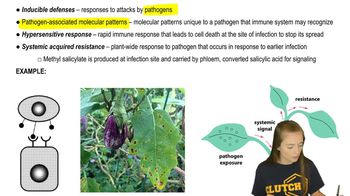
Pathogen Defenses

Coevolutionary Arms Race

A coevolutionary arms race refers to the dynamic and reciprocal evolutionary adaptations between interacting species, such as predators and prey. As one species evolves a new defense mechanism, the other evolves a counter-strategy, leading to continuous adaptations over time. Inducible defenses can be a result of such evolutionary pressures, enhancing survival and competitive abilities.
Recommended video:
02:45
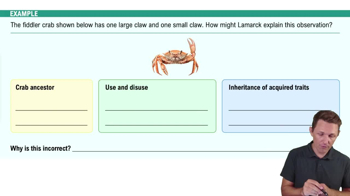
History of Evolutionary Theory Example 1

Resource Efficiency in Defense Mechanisms

Resource efficiency in defense mechanisms is the strategic use of energy and materials by organisms to optimize survival. Inducible defenses exemplify this concept by being produced only when necessary, thus minimizing the metabolic cost associated with maintaining constant defenses. This efficiency allows organisms to allocate resources to other vital functions when threats are absent.
Recommended video:
Guided course
08:59
Pathogen Defenses