Pearson+ LogoPearson+ Logo
Ch. 52 - Community Ecology
Freeman - Biological Science 8th Edition
Freeman8th EditionBiological ScienceISBN: 9780138276263Not the one you use?Change textbook
Chapter 52, Problem 13b

The carnivorous plant Nepenthes bicalcarata ('fanged pitcher plant') has a unique relationship with a species of ant—Camponotus schmitzi ('diving ant'). The diving ants are not digested by the pitcher plants, but instead live on the plants and consume nectar. Diving ants also dive into the digestive juices in the pitcher, swim to the bottom, and capture and consume trapped insects, leaving uneaten body parts and ant feces behind.
What nutritional impact do the ants have on fanged pitcher plants?
Do the pitcher plants derive any nutritional benefit from this relationship?
Based on the background information presented here, does the relationship between diving ants and pitcher plants appear to be mutualistic? Explain.

Verified step by step guidance
1
Begin by understanding the concept of mutualism in biology, which is a type of symbiotic relationship where both parties involved benefit from the interaction.
Consider the role of the diving ants in the ecosystem of the fanged pitcher plant. The ants consume nectar from the plant, which is a direct benefit to them, but they also contribute to the plant's nutrient acquisition by leaving behind uneaten insect parts and ant feces.
Analyze how the uneaten insect parts and ant feces can benefit the pitcher plant. These materials can decompose and release nutrients such as nitrogen and phosphorus, which are essential for the plant's growth and development.
Evaluate the mutualistic aspect of the relationship: the ants receive food and shelter from the pitcher plant, while the plant gains additional nutrients from the ants' activities, enhancing its ability to thrive in nutrient-poor environments.
Conclude that the relationship between the diving ants and the fanged pitcher plant is mutualistic, as both organisms derive significant benefits from their interaction, with the ants aiding in nutrient acquisition for the plant and the plant providing sustenance and habitat for the ants.

Verified video answer for a similar problem:

This video solution was recommended by our tutors as helpful for the problem above.
Video duration:
50s
Was this helpful?

Key Concepts

Here are the essential concepts you must grasp in order to answer the question correctly.

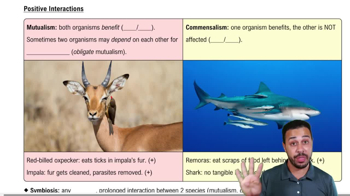
Mutualism

Mutualism is a type of symbiotic relationship where both parties involved benefit from the interaction. In the context of Nepenthes bicalcarata and Camponotus schmitzi, mutualism would imply that both the pitcher plant and the diving ants gain nutritional or survival advantages from their association, such as the ants providing nutrients through their waste and the plant offering a habitat and food source.
Recommended video:
Guided course
02:56
Positive Interactions

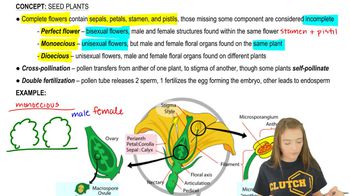
Carnivorous Plant Nutrition

Carnivorous plants like Nepenthes bicalcarata obtain nutrients by trapping and digesting insects, supplementing the poor nutrient availability in their native soil. The digestive juices in the pitcher break down prey, allowing the plant to absorb essential nutrients like nitrogen and phosphorus. The presence of ants might alter this process by contributing additional nutrients through their waste or by processing trapped insects differently.
Recommended video:
Guided course
10:21
Seed Plants - 4

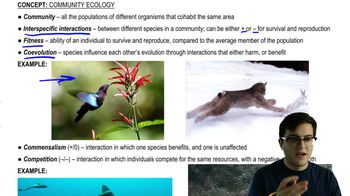
Ant-Plant Interactions

Ant-plant interactions can range from mutualistic to parasitic, depending on the benefits each party receives. In the case of Nepenthes bicalcarata and Camponotus schmitzi, the ants consume nectar and prey, potentially aiding the plant by cleaning the pitcher and providing nutrients through their waste. Understanding these interactions helps determine whether the relationship is mutualistic, benefiting both the ants and the plant.
Recommended video:
Guided course
04:25
Interspecific Interactions
Related Practice
Textbook Question

Lyme disease is caused by infections of the bacterium Borrelia burgdorferi (stained blue in the inset, among red blood cells), which is transferred to humans via blood-sucking bites from the tick Ixodes scapularis. Lyme disease can cause flu-like symptoms in the short term and more serious illnesses in the long term if not treated.

Why is Lyme disease on the rise in eastern North America?

In relation to humans, B. burgdorferi is a/an ____________ and the tick is a/an _____________.

a. endoparasite/ectoparasite

b. endoparasite/host

c. parasitoid/host

d. parasite/predator

Textbook Question

The carnivorous plant Nepenthes bicalcarata ('fanged pitcher plant') has a unique relationship with a species of ant—Camponotus schmitzi ('diving ant'). The diving ants are not digested by the pitcher plants but instead live on the plants and consume nectar. Diving ants also dive into the digestive juices in the pitcher, swim to the bottom, and capture and consume trapped insects, leaving uneaten body parts and ant feces behind.

What nutritional impact do the ants have on fanged pitcher plants?

Do the pitcher plants derive any nutritional benefit from this relationship?

Researchers tested the hypothesis that the relationship between diving ants and pitcher plants is mutualistic (i.e., both species derive a nutritional benefit). To do so, they compared leaf surface area (as a measure of overall growth) in two sets of pitcher plants: plants with diving ants and plants without. The results are shown in the graph. The P values indicate whether there is a significant relationship between the size of the host plants and the surface area of the host plants' leaves. Based on this graph, what conclusions can be drawn about the impact of diving ants on overall plant growth?

Textbook Question

Lyme disease is caused by infections of the bacterium Borrelia burgdorferi (stained blue in the inset, among red blood cells), which is transferred to humans via blood-sucking bites from the tick, Ixodes scapularis. Lyme disease can cause flu-like symptoms in the short term and more serious illnesses in the long term if not treated.

Why is Lyme disease on the rise in eastern North America?

Newly hatched ticks do not harbor B. burgdorferi. Rather, they pick it up from certain hosts that are reservoirs of the bacterium. When a larval tick crawls onto a host, it may get groomed off and killed by the host, or it may feed successfully, in which case it may or may not then become infected with B. burgdorferi. Felicia Keesing and others measured the rate of tick feeding and infection on different hosts.

What percentage of ticks on mice were infected with B. burgdorferi? What percentage of ticks on opossums were groomed off and killed?

Textbook Question

Lyme disease is caused by infections of the bacterium Borrelia burgdorferi (stained blue in the inset, among red blood cells), which is transferred to humans via blood-sucking bites from the tick Ixodes scapularis. Lyme disease can cause flu-like symptoms in the short term and more serious illnesses in the long term if not treated.

Why is Lyme disease on the rise in eastern North America?

Deer are hosts of ticks but are not reservoirs of B. burgdorferi—their immune systems detect and kill the bacterium. But a tick with a prior bacterial infection can consume a blood meal from a deer and then bite and infect a human. The fitness effects of a deer on B. burgdorferi can be summarized as:

a. + because the deer supplies the bacterium with food.

b. − because the deer kills the bacteria in its blood.

c. + because the deer feeds and disperses the tick that can then infect a human with the bacterium.

d. − or + depending on whether the deer is the tick's last host.

Textbook Question

The carnivorous plant Nepenthes bicalcarata ('fanged pitcher plant') has a unique relationship with a species of ant—Camponotus schmitzi ('diving ant'). The diving ants are not digested by the pitcher plants but instead live on the plants and consume nectar. Diving ants also dive into the digestive juices in the pitcher, swim to the bottom, and capture and consume trapped insects, leaving uneaten body parts and ant feces behind.

What nutritional impact do the ants have on fanged pitcher plants?

Do the pitcher plants derive any nutritional benefit from this relationship?

Explain why carnivorous and parasitic plants are most common in nutrient-poor habitats.

Textbook Question

Lyme disease is caused by infections of the bacterium Borrelia burgdorferi (stained blue in the inset, among red blood cells), which is transferred to humans via blood-sucking bites from the tick, Ixodes scapularis. Lyme disease can cause flu-like symptoms in the short term and more serious illnesses in the long term if not treated.

Why is Lyme disease on the rise in eastern North America?

Researchers have measured a positive correlation between forest fragmentation and incidence of Lyme disease. According to the theory of island biogeography, how do you predict fragmentation will affect species richness?