
Textbook Question
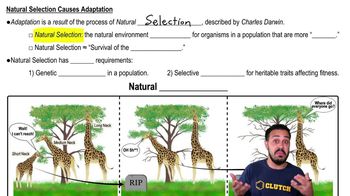
A behavior is considered adaptive if it increases an individual's fitness. How is fitness measured? Select True or False for each statement.
T/F Strength
T/F Body size
T/F Speed
T/F Number of viable offspring


 Verified step by step guidance
 02:37
02:37
 07:48
07:48 04:25
04:25A behavior is considered adaptive if it increases an individual's fitness. How is fitness measured? Select True or False for each statement.
T/F Strength
T/F Body size
T/F Speed
T/F Number of viable offspring
Why does altruism seem paradoxical?
a. Sometimes altruistic behavior is actually selfish.
b. Altruism does not actually help others.
c. Alleles that cause an organism to behave altruistically should be selected against since these alleles should lower the organism's fitness.
d. Animals behave altruistically to help the species, but sometimes their behavior harms the species.
Is it true that all organisms forage optimally? Why or why not?
Propose an evolutionary hypothesis to explain the observation that some bird populations do not migrate if people supply food for them in feeders.
Hamilton's rule states that an altruistic allele could spread in a population if Br > C, where B represents the fitness benefit to the recipient, r is the coefficient of relatedness between altruist and recipient, and C represents the fitness cost to the altruist. If r = 0.5 between the altruist and the recipient, what would the ratio of costs to benefits have to be for the altruistic allele to spread?
a. C/ B > 0.5
b. C/ B > 0
c. C/ B < 0.5
d. C/ B < 0
Evolutionary biologist Hopi Hoekstra and colleagues have hypothesized that the burrow-digging behavior of mice (and the resulting shape of their underground burrows) is heritable—innate and not learned. Design an experiment to test this hypothesis.