Pearson+ LogoPearson+ Logo
Ch. 44 - Animal Sensory Systems
Freeman - Biological Science 8th Edition
Freeman8th EditionBiological ScienceISBN: 9780138276263Not the one you use?Change textbook
Chapter 44, Problem 2

Evaluate the following statements according to the information presented in this chapter. Select True or False for each statement.
T/F Most human eyes have one type of rod and three types of cones.
T/F Rods are more sensitive to dim light than cones are.
T/F Nocturnal animals have fewer rods than diurnal animals.
T/F Both rods and cones use retinal and opsins to detect light.

Verified step by step guidance
1
Understand the function of rods and cones in the human eye: Rods are responsible for vision in low light conditions, while cones are responsible for color vision and function best in bright light.
Evaluate the statement about the types of rods and cones: Most human eyes have one type of rod and three types of cones, which are sensitive to different wavelengths of light (red, green, and blue).
Consider the sensitivity of rods and cones: Rods are more sensitive to dim light than cones, which is why they are more effective in low-light conditions.
Analyze the statement about nocturnal and diurnal animals: Nocturnal animals typically have more rods than diurnal animals to enhance their ability to see in the dark.
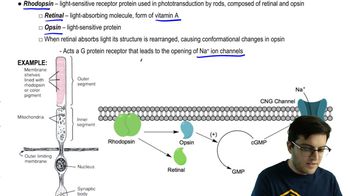
Examine the use of retinal and opsins: Both rods and cones use retinal and opsins to detect light, which are essential components of the phototransduction pathway.

Verified video answer for a similar problem:

This video solution was recommended by our tutors as helpful for the problem above.
Video duration:
1m
Was this helpful?

Key Concepts

Here are the essential concepts you must grasp in order to answer the question correctly.

Rod and Cone Cells

Rod and cone cells are photoreceptor cells in the retina responsible for vision. Rods are highly sensitive to low light levels and are crucial for night vision, while cones are responsible for color vision and function best in bright light. Humans typically have one type of rod and three types of cones, each sensitive to different wavelengths of light.
Recommended video:
Guided course
05:33
Cell Junctions

Sensitivity to Light

Sensitivity to light refers to the ability of photoreceptor cells to detect light intensity. Rods are more sensitive to dim light compared to cones, making them essential for vision in low-light conditions. This sensitivity allows rods to function effectively at night or in dark environments, whereas cones require brighter light to activate and provide detailed color vision.
Recommended video:
Guided course
15:15
Steps of the Light Reactions

Retinal and Opsins

Retinal and opsins are molecules involved in the phototransduction process, which is the conversion of light into electrical signals in the retina. Both rods and cones use retinal, a form of vitamin A, and opsins, proteins that bind to retinal, to detect light. The interaction between retinal and opsins triggers a biochemical cascade that ultimately leads to visual perception.
Recommended video:
Guided course
05:24
Photoreceptors
Related Practice