Pearson+ LogoPearson+ Logo
Ch.4 - Nucleic Acids and the RNA World
Freeman - Biological Science 8th Edition
Freeman8th EditionBiological ScienceISBN: 9780138276263Not the one you use?Change textbook
Chapter 4, Problem 10

In the field of nanotechnology, single-stranded DNA molecules are used like Velcro to assemble tiny particles (<0.0001 mm) into structures by complementary base pairing. If the single-stranded DNA molecules are all 20 bases in length, how many different connections could be made between the particles?

Verified step by step guidance
1
Identify the components of DNA that are relevant to the problem: DNA is composed of four different nucleotides (adenine, thymine, cytosine, and guanine).
Understand the concept of complementary base pairing: Adenine (A) pairs with Thymine (T) and Cytosine (C) pairs with Guanine (G).
Recognize that each position in the 20-base long single-stranded DNA can be occupied by any of the four nucleotides.
Calculate the total number of possible sequences for a 20-base long strand by raising the number of nucleotide options (4) to the power of the number of positions (20).
Consider that each unique 20-base sequence can potentially pair with its complementary sequence, allowing for the formation of connections between particles.

Key Concepts

Here are the essential concepts you must grasp in order to answer the question correctly.

Complementary Base Pairing

Complementary base pairing is a fundamental principle in molecular biology where specific nucleotide bases pair with each other: adenine (A) pairs with thymine (T), and cytosine (C) pairs with guanine (G). This specificity allows for the formation of stable DNA structures and is crucial in processes like DNA replication and transcription. In the context of the question, it explains how single-stranded DNA can selectively bind to other strands, facilitating the assembly of particles.
Recommended video:

DNA Sequence Combinations

The number of different DNA sequences that can be formed is determined by the length of the DNA strand and the four nucleotide bases available (A, T, C, G). For a single-stranded DNA molecule that is 20 bases long, the total number of unique sequences is calculated as 4 raised to the power of 20, which represents all possible combinations of the four bases at each position in the strand. This concept is essential for understanding the potential diversity of connections between particles.
Recommended video:
Guided course
02:13
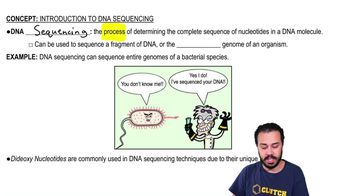
Introduction to DNA Sequencing

Nanotechnology and Self-Assembly

Nanotechnology involves manipulating matter at the nanoscale, typically between 1 and 100 nanometers. Self-assembly is a process where molecules spontaneously organize into structured arrangements without external guidance, often driven by chemical interactions like hydrogen bonding or hydrophobic effects. In this question, the use of single-stranded DNA as a 'Velcro' mechanism highlights how biological principles can be applied in nanotechnology to create complex structures from simple components.
Recommended video:
Guided course
05:48
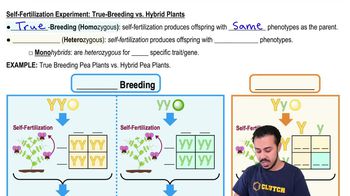
Self-Fertilization Experiment: True-Breeding vs. Hybrid Plants