
Textbook Question
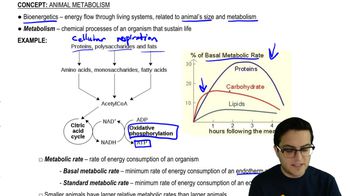
Explain why most endotherms are homeothermic and most ectotherms are poikilothermic.


 Verified step by step guidance
 07:08
07:08
 03:31
03:31 04:58
04:58Explain why most endotherms are homeothermic and most ectotherms are poikilothermic.
Which of the following statements regarding surface area and volume in animals are correct? Select True or False for each statement.
T/FAs an animal grows, its volume increases more rapidly than its surface area.
T/FA chihuahua has a higher surface area to volume ratio than a Great Dane.
T/FAnimals with high surface area to volume ratios heat and cool more slowly than animals with lower surface area to volume ratios.
T/FAs an animal's volume increases, its total surface area decreases.
Which of the following is an advantage that ectotherms have over endotherms of the same size?
a. They require much less food.
b. They are less vulnerable to predation during cold weather.
c. They can remain active in cold weather or on cold nights.
d. They have higher metabolic rates and grow more quickly.
For each of the following, explain how structure relates to function:
absorptive sections of the digestive tract;
capillaries;
beaks of Galápagos finches;
fish gills.
Consider three spheres with radii of 1 cm, 5 cm, and 10 cm.
Calculate the surface area and the volume of each sphere, and plot the results on a graph with radius on the x-axis and surface area and volume on the y-axis. (Surface area of a sphere = 4πr2; volume of a sphere = (4/3)πr3.)
Explain how the graph shows the relationship between size and surface area to volume ratio.