
Pearson+ LogoPearson+ Logo
Ch. 37 - Plant Sensory Systems, Signals, and Responses
Freeman - Biological Science 8th Edition
Freeman8th EditionBiological ScienceISBN: 9780138276263Not the one you use?Change textbook
Chapter 37, Problem 5

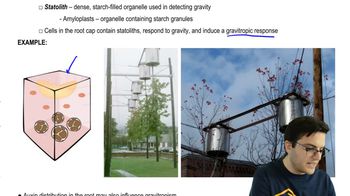
Why was it logical to predict that amyloplasts function as statoliths?
a. They are dense and settle to the bottom of gravity-sensing cells.
b. They are present only in gravity-sensing cells.
c. They make a direct physical connection with membrane proteins that have been shown to be gravity-receptor molecules.
d. Their density changes in response to gravity.

Verified step by step guidance
1
Understand the role of amyloplasts: Amyloplasts are organelles in plant cells that store starch. They are known to be involved in gravity sensing, particularly in root cells.
Define statoliths: Statoliths are specialized structures that help organisms sense gravity. In plants, they are thought to be involved in the perception of gravity by settling in response to gravitational pull.
Consider the properties of amyloplasts: Amyloplasts are dense due to the starch they contain, which makes them heavier than the surrounding cytoplasm.
Analyze the options: Option (a) suggests that amyloplasts settle to the bottom of gravity-sensing cells due to their density, which aligns with the behavior expected of statoliths.
Evaluate the logic: Since amyloplasts are dense and can settle in response to gravity, it is logical to predict that they function as statoliths, as this settling could trigger a response in the plant to orient itself according to gravity.

Verified video answer for a similar problem:

This video solution was recommended by our tutors as helpful for the problem above.
Video duration:
2m
Was this helpful?

Key Concepts

Here are the essential concepts you must grasp in order to answer the question correctly.

Amyloplasts

Amyloplasts are non-pigmented organelles found in plant cells, primarily responsible for the synthesis and storage of starch granules. They are dense structures that can settle within cells, making them potential candidates for gravity sensing due to their ability to move in response to gravitational forces.
Recommended video:

Statoliths

Statoliths are specialized organelles or structures within cells that help organisms sense gravity. In plants, they are typically dense particles that can move within gravity-sensing cells, providing positional information that aids in the plant's orientation and growth direction relative to gravity.
Recommended video:

Gravity Sensing in Plants

Gravity sensing in plants involves the detection of gravitational forces to orient growth and development. This process often relies on the movement of dense organelles like amyloplasts within specialized cells, which interact with membrane proteins to trigger signaling pathways that adjust the plant's growth direction.
Recommended video:
Guided course
07:47
Making Sense of Ecosystem Production & Efficiency
Related Practice
Textbook Question

Which of the following statements about phytochrome is not correct?

a. It is photoreversible.

b. Its function was understood long before the protein itself was isolated.

c. The Pfr form activates the responses to red light.

d. It is involved in guard-cell opening.

1
views
Textbook Question

Which of the following statements about hormones is correct?

a. They tend to be large molecules.

b. They exert their effects only on the same cells that produce them.

c. They can exert strong effects only when they are present in high concentrations.

d. They trigger a response by binding to target-cell receptors.

Textbook Question

What evidence suggests that ABA from roots can signal guard cells to close?

a. If roots are given sufficient water, guard cells close anyway.

b. If roots are dry, guard cells begin to close—even though leaves may not be experiencing water stress.

c. Applying ABA to guard cells directly causes them to close.

d. If roots are dry, the ABA concentration in leaf cells drops dramatically.

Textbook Question

Phytochromes can be considered 'shade detectors,' while phototropins such as PHOT1 can be considered 'sunlight detectors.' Explain why these characterizations are valid.

Textbook Question

To explore how hormones function, researchers have begun to transform plants with particular genes. In one experiment, a gene involved in cytokinin synthesis was introduced into tobacco plants. Which one of the following results would be expected?

a. Individuals produced more lateral branches.

b. Stems grew extremely tall and slender.

c. Roots were incapable of responding to gravity.

d. Stomata were closed most of the time.

Textbook Question

Suppose that a mutant plant is unable to make methyl salicylate. Explain why it is not likely to survive in the wild.