Pearson+ LogoPearson+ Logo
Ch. 31 - Protostome Animals
Freeman - Biological Science 8th Edition
Freeman8th EditionBiological ScienceISBN: 9780138276263Not the one you use?Change textbook
Chapter 31, Problem 9

The pygmy zebra octopus is a potential new model organism for understanding brain function in humans despite the independent evolution of high intelligence in both groups. Describe (or draw a phylogenetic tree to show) the relationships among humans (H. sapiens), the pygmy zebra octopus (O. chierchiae) and two other protostome model organisms in medicine: the fruitfly (D. melanogaster) and roundworm (C. elegans).

Verified step by step guidance
1
Identify the major taxonomic groups for each organism: Humans belong to the phylum Chordata, class Mammalia. The pygmy zebra octopus belongs to the phylum Mollusca, class Cephalopoda. The fruitfly belongs to the phylum Arthropoda, class Insecta. The roundworm belongs to the phylum Nematoda.
Understand the concept of a phylogenetic tree, which is used to show the evolutionary relationships among various biological species based upon similarities and differences in their physical or genetic characteristics.
Place the common ancestor of all these organisms at the base of the tree. This represents the last universal common ancestor (LUCA) from which all life on earth diverged.
Branch out from the LUCA to form two main groups: Protostomes (which include Mollusca, Arthropoda, and Nematoda) and Deuterostomes (which include Chordata). This division is based on the developmental process of the embryo.
Further divide the Protostomes into their respective phyla (Mollusca for the octopus, Arthropoda for the fruitfly, and Nematoda for the roundworm) and place the Deuterostome (Chordata for humans) on a separate branch. This will visually represent the evolutionary distance and relationships among the organisms.

Key Concepts

Here are the essential concepts you must grasp in order to answer the question correctly.

Phylogenetic Tree

A phylogenetic tree is a diagram that represents the evolutionary relationships among various biological species based on their genetic or physical characteristics. It illustrates how species diverged from common ancestors over time, allowing researchers to visualize the lineage and evolutionary history of organisms. In this context, constructing a phylogenetic tree helps to clarify the relationships between humans, the pygmy zebra octopus, and other model organisms.
Recommended video:
04:13
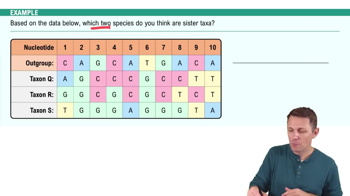
Building Phylogenetic Trees Example 2

Protostomes

Protostomes are a major group of animals characterized by their embryonic development, where the mouth forms before the anus. This group includes diverse organisms such as arthropods and mollusks, which are often used as model organisms in biological research. Understanding protostome biology is crucial for comparing the evolutionary pathways and functional similarities between species like the pygmy zebra octopus and other model organisms like fruit flies and roundworms.
Recommended video:
Guided course
06:59
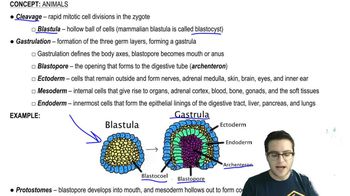
Overview of Animals - 2

Model Organisms

Model organisms are non-human species that are extensively studied to understand biological processes, disease mechanisms, and genetic functions that may be applicable to humans. They are chosen for their ease of maintenance, rapid reproduction, and genetic tractability. The fruit fly and roundworm are classic examples, providing insights into genetics and development, which can be compared to the potential insights gained from studying the pygmy zebra octopus.
Recommended video:
Guided course
01:09
Introduction to Population Growth Models
Related Practice
Textbook Question

Pose a hypothesis to explain why the evolution of the wing was such an important event in the evolution of insects.

Textbook Question

Which of these choices is an example of homology (similarity due to common ancestry)?

a. Suspension feeding in sponges and clams

b. Ectoparasite lifestyle in aphids and ticks

c. Cnidocytes (stinging cells) in jellyfish and sea anemones

d. Radial symmetry in cnidarians and echinoderms

1
views
Textbook Question

Evaluate this statement: Evolution is said to occur when new traits accumulate over time, increasing complexity.

1
views
Textbook Question

A team of 102 scientists spent a year surveying a small area of the San Lorenzo rain forest in Panama to count the number of species of arthropods living there. After collecting 129,494 specimens—using nets, traps, shovels, tree-climbing harnesses, helium balloons, and other creative gear—it took the team eight years to sort and identify the arthropods. Which of the following nested groups best describes the taxonomic context for the San Lorenzo project?

a. Animalia > Bilateria > Arthropoda > Ecdysozoa

b. Protostomia > Lophotrochozoa > Ecdysozoa > Arthropoda

c. Arthropoda > Protostomia > Ecdysozoa > Bilateria

d. Bilateria > Protostomia > Ecdysozoa > Arthropoda

Textbook Question

A team of 102 scientists spent a year surveying a small area of the San Lorenzo rain forest in Panama to count the number of species of arthropods living there. After collecting 129,494 specimens—using nets, traps, shovels, tree-climbing harnesses, helium balloons, and other creative gear—it took the team eight years to sort and identify the arthropods. Rather than measuring the entire 6000-hectare (ha) forest, the researchers sampled arthropod diversity by intensively collecting as many arthropods as they could in 12 plots that measured 20 m × 20m square. If 1 ha=10,000 m², how many hectares of forest did they sample in all?

a. 20 m×20 m×12=4800 ha

b. 4800 m²×10,000 m²/1 ha=48,000,000 ha

c. 20 m×20 m=400 ha

d. 4800 m² x ha/10,000 m² = 0.48 ha

Textbook Question

A team of 102 scientists spent a year surveying a small area of the San Lorenzo rain forest in Panama to count the number of species of arthropods living there. After collecting 129,494 specimens—using nets, traps, shovels, tree-climbing harnesses, helium balloons, and other creative gear—it took the team eight years to sort and identify the arthropods. The graph below shows some of the data for the major arthropod groups collected. Notice that the scale on the y-axis is logarithmic to make both small and large numbers legible on the same graph. For example, there are about 400 species of spiders but only 40 species of bees.

About how many arthropods were found in total?

About what percentage of these were beetles?