Pearson+ LogoPearson+ Logo
Ch. 31 - Protostome Animals
Freeman - Biological Science 8th Edition
Freeman8th EditionBiological ScienceISBN: 9780138276263Not the one you use?Change textbook
Chapter 31, Problem 1

Rank the three most diverse phyla of protostome animals.


a. Arthropoda > Mollusca > Nematoda
b. Mollusca > Arthropoda > Nematoda
c. Arthropoda > Nematoda > Mollusca

Verified step by step guidance
1
Understand the term 'diverse' in the context of biological classification, which refers to the variety and abundance of species within each phylum.
Review the characteristics of the phylum Arthropoda, which includes insects, arachnids, myriapods, and crustaceans, known for their jointed limbs and exoskeleton.
Examine the phylum Mollusca, which encompasses a range of species from snails and clams to octopuses, characterized by a soft body and often a hard shell.
Look into the phylum Nematoda, or roundworms, which are mostly microscopic and ubiquitous in diverse habitats but less varied in form compared to Arthropoda and Mollusca.
Compare the species richness and variety of body forms among these phyla to determine the ranking of diversity from greatest to least.

Key Concepts

Here are the essential concepts you must grasp in order to answer the question correctly.

Protostome Development

Protostomes are a group of animals characterized by their embryonic development, where the mouth forms before the anus. This developmental pathway is a key feature that distinguishes them from deuterostomes. Understanding protostome development is essential for classifying and ranking the diverse phyla within this group.
Recommended video:
Guided course
06:02
Embryonic Plant Development

Diversity of Phyla

Diversity in biological terms refers to the variety of life forms within a given ecosystem or taxonomic group. In the context of protostomes, the three phyla in question—Arthropoda, Mollusca, and Nematoda—exhibit significant diversity in terms of species richness, ecological roles, and morphological adaptations, making them crucial for understanding evolutionary relationships.
Recommended video:
Guided course
03:05
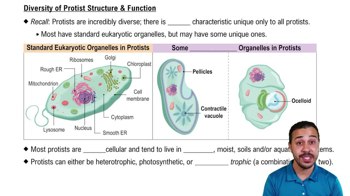
Diversity of Protist Structure & Function

Phylogenetic Relationships

Phylogenetic relationships illustrate the evolutionary connections between different groups of organisms. By analyzing genetic, morphological, and ecological data, scientists can construct phylogenetic trees that help rank the diversity of phyla. This understanding is vital for determining which phyla are more diverse and how they relate to one another within the protostome clade.
Recommended video:
04:13
Building Phylogenetic Trees Example 2