
Pearson+ LogoPearson+ Logo
Ch. 31 - Protostome Animals
Freeman - Biological Science 8th Edition
Freeman8th EditionBiological ScienceISBN: 9780138276263Not the one you use?Change textbook
Chapter 31, Problem 14d

A team of 102 scientists spent a year surveying a small area of the San Lorenzo rain forest in Panama to count the number of species of arthropods living there. After collecting 129,494 specimens—using nets, traps, shovels, tree-climbing harnesses, helium balloons, and other creative gear—it took the team eight years to sort and identify the arthropods. A team of 102 scientists spent a year surveying a small area of the San Lorenzo rain forest in Panama to count the number of species of arthropods living there. After collecting 129,494 specimens—using nets, traps, shovels, tree-climbing harnesses, helium balloons, and other creative gear—it took the team eight years to sort and identify the arthropods. Use the data in the graph to analyze the following statements.
Select True or False for each statement, then correct any false statements to make them true.
T/FAll taxa shown in the graph are insects.
T/FAll taxa shown in the graph have segmented bodies and limbs.
T/FAll taxa shown in the graph are terrestrial.
T/FIf the researchers had sampled for mollusks, they probably would have found almost as many species as they did for arthropods.

Verified step by step guidance
1
Step 1: Analyze the first statement: 'All taxa shown in the graph are insects.' Recall that arthropods include a variety of taxa such as insects, arachnids, crustaceans, and myriapods. Review the graph to determine if all taxa listed are insects or if other arthropod groups are represented.
Step 2: Analyze the second statement: 'All taxa shown in the graph have segmented bodies and limbs.' Understand that arthropods are characterized by having segmented bodies and jointed limbs. Confirm this by reviewing the taxa in the graph and ensuring they all belong to the arthropod phylum.
Step 3: Analyze the third statement: 'All taxa shown in the graph are terrestrial.' Note that while many arthropods are terrestrial, some groups, such as crustaceans, may include aquatic species. Check the graph to see if any aquatic taxa are represented.
Step 4: Analyze the fourth statement: 'If the researchers had sampled for mollusks, they probably would have found almost as many species as they did for arthropods.' Compare the diversity of arthropods to mollusks. Recall that arthropods are the most diverse group of animals, significantly outnumbering mollusks in terms of species richness. Use this biological principle to evaluate the statement.
Step 5: For any statement determined to be false, rewrite it to make it true. For example, if the first statement is false because not all taxa are insects, correct it to reflect the diversity of arthropod taxa shown in the graph.

Verified video answer for a similar problem:

This video solution was recommended by our tutors as helpful for the problem above.
Video duration:
2m
Was this helpful?

Key Concepts

Here are the essential concepts you must grasp in order to answer the question correctly.

Arthropod Diversity

Arthropods are a diverse group of invertebrates that include insects, arachnids, crustaceans, and myriapods. They are characterized by their segmented bodies, exoskeletons made of chitin, and jointed appendages. Understanding the diversity within arthropods is crucial for analyzing ecological data, as different groups may exhibit varying ecological roles and adaptations.
Recommended video:
Guided course
08:01
Arthropods and Chelicerata

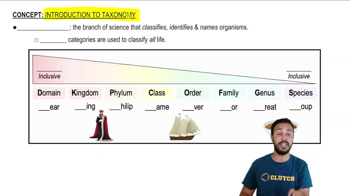
Taxonomy and Classification

Taxonomy is the science of classifying organisms into hierarchical categories based on shared characteristics. In the context of the question, understanding the classification of arthropods and other taxa is essential for determining whether all taxa in the graph are insects or if they belong to different groups, which can affect the accuracy of the statements provided.
Recommended video:
Guided course
02:23
Introduction to Taxonomy

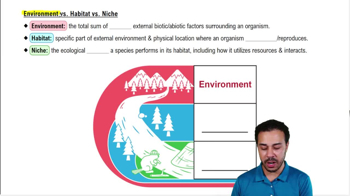
Habitat and Ecology

Habitat refers to the natural environment in which a species lives, while ecology studies the interactions between organisms and their environment. The question involves assessing whether all taxa are terrestrial, which requires knowledge of the habitats of different arthropod groups and their ecological niches. This understanding is vital for evaluating the statements about species distribution and habitat preferences.
Recommended video:
Guided course
01:57
Environment vs. Habitat vs. Niche
Related Practice
Textbook Question

A team of 102 scientists spent a year surveying a small area of the San Lorenzo rain forest in Panama to count the number of species of arthropods living there. After collecting 129,494 specimens—using nets, traps, shovels, tree-climbing harnesses, helium balloons, and other creative gear—it took the team eight years to sort and identify the arthropods. Which of the following nested groups best describes the taxonomic context for the San Lorenzo project?

a. Animalia > Bilateria > Arthropoda > Ecdysozoa

b. Protostomia > Lophotrochozoa > Ecdysozoa > Arthropoda

c. Arthropoda > Protostomia > Ecdysozoa > Bilateria

d. Bilateria > Protostomia > Ecdysozoa > Arthropoda

Textbook Question

A team of 102 scientists spent a year surveying a small area of the San Lorenzo rain forest in Panama to count the number of species of arthropods living there. After collecting 129,494 specimens—using nets, traps, shovels, tree-climbing harnesses, helium balloons, and other creative gear—it took the team eight years to sort and identify the arthropods. Rather than measuring the entire 6000-hectare (ha) forest, the researchers sampled arthropod diversity by intensively collecting as many arthropods as they could in 12 plots that measured 20 m × 20m square. If 1 ha=10,000 m², how many hectares of forest did they sample in all?

a. 20 m×20 m×12=4800 ha

b. 4800 m²×10,000 m²/1 ha=48,000,000 ha

c. 20 m×20 m=400 ha

d. 4800 m² x ha/10,000 m² = 0.48 ha

Textbook Question

A team of 102 scientists spent a year surveying a small area of the San Lorenzo rain forest in Panama to count the number of species of arthropods living there. After collecting 129,494 specimens—using nets, traps, shovels, tree-climbing harnesses, helium balloons, and other creative gear—it took the team eight years to sort and identify the arthropods. The graph below shows some of the data for the major arthropod groups collected. Notice that the scale on the y-axis is logarithmic to make both small and large numbers legible on the same graph. For example, there are about 400 species of spiders but only 40 species of bees.

About how many arthropods were found in total?

About what percentage of these were beetles?

Textbook Question

A team of 102 scientists spent a year surveying a small area of the San Lorenzo rain forest in Panama to count the number of species of arthropods living there. After collecting 129,494 specimens—using nets, traps, shovels, tree-climbing harnesses, helium balloons, and other creative gear—it took the team eight years to sort and identify the arthropods. By comparing the number of arthropod species that were common among the 12 plots sampled, the researchers estimated that the total number of arthropods in the whole San Lorenzo forest is 25,000 species.

To come up with this estimate, what's one assumption the researchers had to make about the forest?

Textbook Question

A team of 102 scientists spent a year surveying a small area of the San Lorenzo rain forest in Panama to count the number of species of arthropods living there. After collecting 129,494 specimens—using nets, traps, shovels, tree-climbing harnesses, helium balloons, and other creative gear—it took the team eight years to sort and identify the arthropods. The researchers observed a strong correlation between the number of arthropod species and the number of plant species in the San Lorenzo forest.

Pose an evolutionary hypothesis to explain this correlation.