Pearson+ LogoPearson+ Logo
Ch.3 - Protein Structure and Function
Freeman - Biological Science 8th Edition
Freeman8th EditionBiological ScienceISBN: 9780138276263Not the one you use?Change textbook
Chapter 3, Problem 4

Which of the following correctly describe an active site? Select True or False for each statement.
T/F It is the location in an enzyme where substrates bind.
T/F It is the place where a molecule or ion binds to an inactive enzyme to induce a shape change to make it active.
T/F It is the portion of an enzyme where chaperones bind to help enzymes fold.
T/F It is the site on an enzyme where catalysis occurs.

Verified step by step guidance
1
Step 1: Understand the concept of an active site. The active site is a specific region on an enzyme where substrates bind and catalysis occurs. It is highly specific to the substrate and plays a critical role in the enzyme's function.
Step 2: Evaluate the first statement: 'It is the location in an enzyme where substrates bind.' This is true because the active site is where substrates bind to the enzyme, initiating the catalytic process.
Step 3: Evaluate the second statement: 'It is the place where a molecule or ion binds to an inactive enzyme to induce a shape change to make it active.' This is false because this describes an allosteric site, not the active site. Allosteric sites are separate regions where molecules bind to regulate enzyme activity.
Step 4: Evaluate the third statement: 'It is the portion of an enzyme where chaperones bind to help enzymes fold.' This is false because chaperones assist in protein folding but do not bind to the active site of enzymes.
Step 5: Evaluate the fourth statement: 'It is the site on an enzyme where catalysis occurs.' This is true because the active site is the region where the chemical reaction (catalysis) takes place, converting substrates into products.

Verified video answer for a similar problem:

This video solution was recommended by our tutors as helpful for the problem above.
Video duration:
1m
Was this helpful?

Key Concepts

Here are the essential concepts you must grasp in order to answer the question correctly.

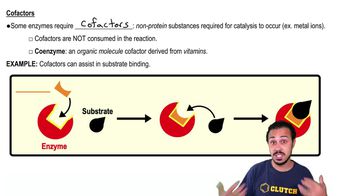
Active Site

The active site of an enzyme is a specific region where substrate molecules bind. This site is typically a pocket or groove on the enzyme's surface, formed by the unique three-dimensional structure of the enzyme. The shape and chemical environment of the active site facilitate the conversion of substrates into products during the catalytic process.
Recommended video:
Guided course
02:37
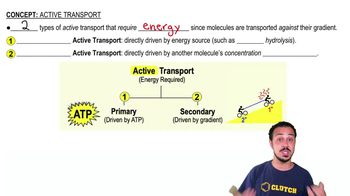
Active Transport

Enzyme Activation

Enzyme activation refers to the process by which an inactive enzyme is converted into its active form, often through the binding of a molecule or ion. This binding can induce a conformational change in the enzyme, allowing it to interact effectively with its substrate. This concept is crucial for understanding how enzymes can be regulated and activated in biological systems.
Recommended video:
Guided course
04:18
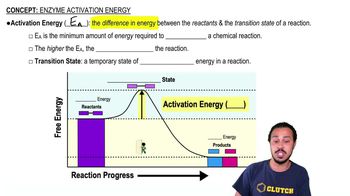
Enzyme Activation Energy

Catalysis

Catalysis is the process by which an enzyme accelerates a chemical reaction. The active site plays a critical role in this process, as it is where the substrate is transformed into the product. Enzymes lower the activation energy required for reactions, allowing them to proceed more quickly and efficiently, which is essential for maintaining metabolic processes in living organisms.
Recommended video:
Related Practice