Pearson+ LogoPearson+ Logo
Ch. 25 - Phylogenies and the History of Life
Freeman - Biological Science 8th Edition
Freeman8th EditionBiological ScienceISBN: 9780138276263Not the one you use?Change textbook
Chapter 25, Problem 12

The vast majority of animals that ever existed are now extinct, but Tereza Jezkova and John Wiens wondered which variables were most important in driving the diversification of species that exist today. Why are there so many species in some phyla, such as Cnidaria, but so few in others, such as Ctenophora? Based on your reading of this chapter, propose at least five traits that you think might have been most important in triggering diversification within phyla (examples: origin of hearing, origin of internal fertilization).

Verified step by step guidance
1
Consider the role of environmental adaptability: Species that can adapt to a wide range of environmental conditions are more likely to diversify. Traits such as tolerance to different temperatures or salinity levels can drive diversification.
Examine reproductive strategies: The origin of internal fertilization or complex mating behaviors can lead to increased speciation by allowing species to exploit new niches or reduce competition.
Evaluate morphological innovations: Traits like the development of specialized body structures (e.g., tentacles in Cnidaria) can enable species to access new resources or habitats, promoting diversification.
Assess ecological interactions: The ability to form symbiotic relationships or develop predatory strategies can lead to diversification by opening up new ecological roles.
Analyze genetic variability: High genetic variability within a phylum can lead to greater potential for adaptation and speciation, as it provides a broader genetic toolkit for responding to environmental changes.

Verified video answer for a similar problem:

This video solution was recommended by our tutors as helpful for the problem above.
Video duration:
3m
Was this helpful?

Key Concepts

Here are the essential concepts you must grasp in order to answer the question correctly.

Evolutionary Diversification

Evolutionary diversification refers to the process by which species evolve and diversify into a wide variety of forms and functions. This can be driven by factors such as environmental changes, genetic mutations, and natural selection, leading to the adaptation of species to different ecological niches. Understanding this concept helps explain why some phyla have more species than others.
Recommended video:
02:45
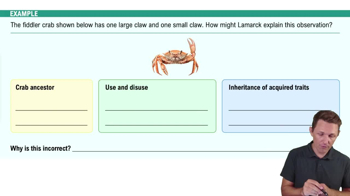
History of Evolutionary Theory Example 1

Adaptive Traits

Adaptive traits are characteristics that enhance the survival and reproduction of organisms in specific environments. These traits can include physical features, behaviors, or physiological processes that provide a competitive advantage. In the context of species diversification, the emergence of new adaptive traits can lead to the exploitation of new niches and the formation of new species.
Recommended video:
05:24
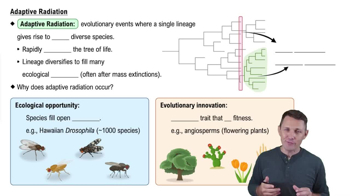
Adaptive Radiation

Speciation

Speciation is the evolutionary process by which populations evolve to become distinct species. It often occurs when populations are isolated geographically or ecologically, leading to genetic divergence. Speciation is a key mechanism in the diversification of life, contributing to the vast array of species observed in different phyla today.
Recommended video:
Guided course
02:53
Allopatric Speciation
Related Practice
Textbook Question

You can use a 'one-snip test' to identify monophyletic groups—meaning that if you 'cut' any branch on a tree, everything that 'falls off' is a monophyletic group. Why is this valid?
Textbook Question

Use the fossil evidence shown in Figure 25.6 to determine whether flight evolved earlier in insects or in birds. Is flight an example of homology or convergent evolution? Explain.

Textbook Question

The vast majority of animals that ever existed are now extinct, but Tereza Jezkova and John Wiens wondered which variables were most important in driving the diversification of species that exist today. Why are there so many species in some phyla, such as Cnidaria (see photo), but so few in others, such as Ctenophora? Jezkova and Wiens used a type of graph called a linear regression to find correlations between variables such as the proportion of species per phylum with legs (on the y-axis) and the diversification rate per phylum (on the x-axis). Sketch a graph to show what a strong positive correlation between these two variables would look like and what the absence of a correlation would look like.

Textbook Question

The vast majority of animals that ever existed are now extinct, but Tereza Jezkova and John Wiens wondered which variables were most important in driving the diversification of species that exist today. Why are there so many species in some phyla, such as Cnidaria (see photo), but so few in others, such as Ctenophora? A sample of Jekova and Wiens' results is shown here. The R2 value represents the strength of the correlation (where 0.00 is lowest and 1.00 is highest). The P value represents the statistical significance. Which five traits look most important?

Textbook Question

Which traits do not correlate strongly with diversification rate within phyla but are likely to have been important in the original diversification of animal phyla during the Cambrian? Select True or False for each trait.

T/F presence of a head

T/F mobile lifestyle

T/F terrestrial lifestyle

T/F bilateral symmetry

2
views