Pearson+ LogoPearson+ Logo
Ch. 24 - Speciation
Freeman - Biological Science 8th Edition
Freeman8th EditionBiological ScienceISBN: 9780138276263Not the one you use?Change textbook
Chapter 24, Problem 4

Evaluate this statement: Gene flow increases the genetic divergence of populations.

Verified step by step guidance
1
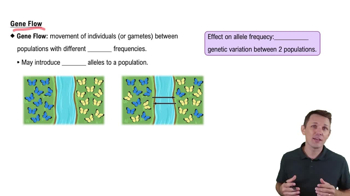
Understand the concept of gene flow: Gene flow refers to the transfer of genetic material (alleles) between populations of the same species through migration and interbreeding. It introduces new alleles into a population or changes allele frequencies.
Recall the concept of genetic divergence: Genetic divergence occurs when populations of the same species accumulate genetic differences over time, often due to limited gene flow, natural selection, or genetic drift. This can eventually lead to speciation.
Analyze the relationship between gene flow and genetic divergence: Gene flow tends to homogenize populations by mixing genetic material, reducing differences between them. This means that gene flow generally decreases genetic divergence rather than increasing it.
Evaluate the statement: The statement 'Gene flow increases the genetic divergence of populations' is incorrect because gene flow typically reduces genetic divergence by promoting genetic similarity between populations.
Conclude with an example: For instance, if two populations of a species are geographically separated and gene flow occurs between them (e.g., through migration), the exchange of alleles will make their gene pools more similar, counteracting divergence.

Verified video answer for a similar problem:

This video solution was recommended by our tutors as helpful for the problem above.
Video duration:
3m
Was this helpful?

Key Concepts

Here are the essential concepts you must grasp in order to answer the question correctly.

Gene Flow

Gene flow, also known as gene migration, refers to the transfer of genetic material between populations through processes such as migration and interbreeding. This exchange can introduce new alleles into a population, thereby increasing genetic diversity. It plays a crucial role in maintaining genetic similarity among populations and can counteract the effects of natural selection and genetic drift.
Recommended video:
01:43
Gene Flow

Genetic Divergence

Genetic divergence occurs when two or more populations accumulate genetic differences over time, often due to factors like natural selection, genetic drift, and mutation. This process can lead to the formation of new species as populations adapt to different environments or ecological niches. High levels of genetic divergence indicate that populations have evolved independently, potentially leading to reproductive isolation.
Recommended video:

Population Genetics

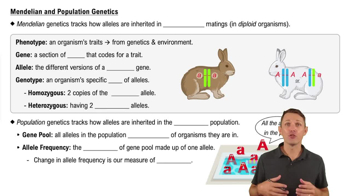
Population genetics is the study of genetic variation within populations and how it changes over time due to evolutionary processes. It examines factors such as gene flow, mutation, selection, and genetic drift, which influence allele frequencies. Understanding population genetics is essential for evaluating statements about gene flow and its impact on genetic divergence, as it provides the framework for analyzing how populations evolve.
Recommended video:
04:26
Mendelian and Population Genetics
Related Practice
Textbook Question

What distinguishes a morphospecies?

a. It has distinctive characteristics, such as size, shape, or coloration.

b. It represents a distinct branch in a phylogeny of populations.

c. It is reproductively isolated from other species.

d. It is a fossil from a distinct time in Earth history.

Textbook Question

Which of the following describes vicariance?

a. Small populations coalesce into one large population.

b. A population is fragmented into isolated subpopulations.

c. Individuals colonize a novel habitat.

d. Individuals disperse and found a new population.

1
views
Textbook Question

Select True or False to indicate which of the following groups could be identified using the biological species concept.

T/F lizard species living today

T/F sunflower species living today

T/F extinct dinosaurs

T/F bacteria living today

Textbook Question

When the ranges of two different species meet, a stable 'hybrid zone' occupied by hybrid individuals may form. How is this possible?

a. Two diverged populations are capable of mating and producing viable and fertile offspring.

b. Hybrid individuals are always allopolyploid and are thus unable to mate with either of the original species.

c. Hybrid individuals may have reduced fitness and thus be strongly selected against.

d. One species has a selective advantage, so as hybridization continues, the other species will go extinct.

Textbook Question

Sexual selection favors individuals with traits that increase their ability to obtain mates, such as mating calls in crickets. Using this example, propose a scenario where sexual selection could contribute to divergence in sympatric speciation.

Textbook Question

If one species (2n = 10) crosses with another species (2n = 18), producing an allopolyploid offspring, what is the ploidy of the offspring?

a. 2n = 10

b. 2n = 18

c. 2n = 10+18 = 28

d. 4n = 36 +20 = 56