Pearson+ LogoPearson+ Logo
Ch. 23 - Evolutionary Processes
Freeman - Biological Science 8th Edition
Freeman8th EditionBiological ScienceISBN: 9780138276263Not the one you use?Change textbook
Chapter 23, Problem 13

Human activities are causing the fragmentation of the Brazilian Atlantic rain forest. One result is that toucans have become extinct or nearly extinct in some of the forest fragments. Does the absence of toucans affect the forest? Toucans can eat fruits with large seeds because their large bills can open wide. Most other birds in the same forest can only eat small seeds. Ecologist Mauro Galetti and his colleagues measured the seed sizes of palms in forest fragments with and without toucans. The graphs show two of the forest populations they studied. What is the take-home message of the data?

Verified step by step guidance
1
Examine the graphs provided. The left graph represents seed diameter distribution in forest fragments where toucans are present, while the right graph represents seed diameter distribution in forest fragments where toucans are absent.
Notice the difference in seed size distribution between the two graphs. In the presence of toucans, there is a wider range of seed sizes, including larger seeds (10-14 mm). In contrast, in the absence of toucans, the seed sizes are predominantly smaller (8-10 mm).
Understand the ecological role of toucans. Toucans are capable of consuming fruits with large seeds due to their large bills, which allows them to disperse these seeds across the forest. Without toucans, larger seeds are less likely to be dispersed, leading to a shift in the population toward smaller seeds.
Consider the implications of this shift. Smaller seeds may dominate in the absence of toucans, potentially affecting palm tree populations and the overall forest ecosystem. This could lead to reduced genetic diversity and changes in forest structure over time.
Conclude that the absence of toucans has a significant impact on seed size distribution, highlighting their critical role in maintaining ecological balance and promoting seed dispersal for plants with larger seeds.

Verified video answer for a similar problem:

This video solution was recommended by our tutors as helpful for the problem above.
Video duration:
4m
Was this helpful?

Key Concepts

Here are the essential concepts you must grasp in order to answer the question correctly.

Seed Dispersal

Seed dispersal is the process by which seeds are spread away from the parent plant to reduce competition and increase the chances of germination. Toucans play a crucial role in this process by consuming large seeds and excreting them in different locations, facilitating the growth of new plants. The absence of toucans can lead to a decline in the dispersal of larger seeds, affecting plant diversity and forest regeneration.
Recommended video:
Guided course
06:26
Seed Plants - 1

Ecological Impact of Species Loss

The loss of a species, such as toucans, can have significant ecological consequences, often leading to a cascade of effects throughout the ecosystem. This phenomenon, known as a trophic cascade, can alter species interactions, reduce biodiversity, and disrupt food webs. In the case of the Brazilian Atlantic rainforest, the decline of toucans may result in fewer large-seeded plants, which can impact other species that rely on these plants for food and habitat.
Recommended video:
Guided course
01:56
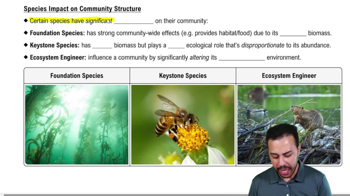
Species Impact on Community Structure

Graph Interpretation

Interpreting graphs is essential for understanding data trends and relationships. The provided histograms illustrate the distribution of seed sizes in forest fragments with and without toucans. The graph on the left shows a wider range of seed sizes when toucans are present, while the right graph indicates a dominance of smaller seeds in their absence, highlighting the impact of toucans on seed size diversity and forest composition.
Recommended video:
03:54
Interpreting Branch Length
Related Practice
Textbook Question

In humans, albinism is caused by loss-of-function mutations in genes involved in the synthesis of melanin, the dark pigment in skin. Only people homozygous for a loss-of-function allele (genotype 𝑎𝑎) have albinism. In one study of an American population, individuals with albinism were present at a frequency of about 1 in 10,000 (or 0.0001). Assuming that genotypes are in Hardy–Weinberg Equilibrium, what is the predicted frequency of individuals who are carriers (that is, 𝐴𝑎) for the albinism allele?

Textbook Question

Suppose you were a conservation biologist working to preserve two populations of monkeys. The first population has 5000 individuals, while the second population has 50,000 individuals. Which population do you expect to have higher genetic diversity? Consider which evolutionary process(es) may be different between these populations. Justify your response.

Textbook Question

Human activities are causing the fragmentation of the Brazilian Atlantic rain forest. One result is that toucans have become extinct or nearly extinct in some of the forest fragments. Does the absence of toucans affect the forest?

Toucans disperse seeds of key forest species such as juçara palms by eating the fruit and defecating the seeds in new locations, sometimes more than a kilometer away. If there are no toucans, is the genetic diversity of palms likely to increase or decrease within forest fragments? Why?

a. Increase (due to increased genetic drift)

b. Decrease (due to decreased gene flow)

c. Decrease (due to decreased mutation rate)

d. Decrease (due to decreased natural selection)