Pearson+ LogoPearson+ Logo
Ch. 22 - Evolution by Natural Selection
Freeman - Biological Science 8th Edition
Freeman8th EditionBiological ScienceISBN: 9780138276263Not the one you use?Change textbook
Chapter 22, Problem 4

How can evolutionary fitness be measured? Select True or False for each statement.
T/F Document how long individuals survive.
T/F Count the number of healthy, fertile offspring produced.
T/F Determine which individuals are strongest.
T/F Determine which phenotype is the most common.

Verified step by step guidance
1
Understand the concept of evolutionary fitness: It refers to an organism's ability to survive and reproduce in its environment. Fitness is often measured by the number of offspring an individual produces that survive to reproduce themselves.
Evaluate the statement 'Document how long individuals survive': Survival alone does not directly measure evolutionary fitness unless it contributes to reproduction. Consider whether longevity leads to more offspring.
Evaluate the statement 'Count the number of healthy, fertile offspring produced': This directly measures evolutionary fitness, as it reflects the individual's contribution to the next generation.
Evaluate the statement 'Determine which individuals are strongest': Physical strength may contribute to survival and reproduction, but it is not a direct measure of evolutionary fitness unless it results in more offspring.
Evaluate the statement 'Determine which phenotype is the most common': Common phenotypes may indicate successful traits, but evolutionary fitness is specifically measured by reproductive success, not just prevalence.

Verified video answer for a similar problem:

This video solution was recommended by our tutors as helpful for the problem above.
Video duration:
2m
Was this helpful?

Key Concepts

Here are the essential concepts you must grasp in order to answer the question correctly.

Evolutionary Fitness

Evolutionary fitness refers to an organism's ability to survive and reproduce in its environment. It is measured by the number of offspring an individual produces that survive to reproduce themselves, thus passing on their genes to the next generation. Fitness is not solely about physical strength but rather the overall reproductive success.
Recommended video:
02:45
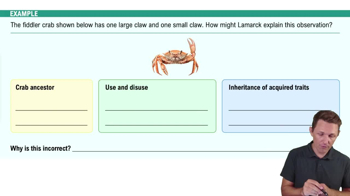
History of Evolutionary Theory Example 1

Survival and Reproduction

Survival and reproduction are key components of evolutionary fitness. While survival is important, the ultimate measure of fitness is the ability to produce viable offspring. An individual that lives longer but does not reproduce does not contribute to the gene pool, thus having lower evolutionary fitness compared to one that reproduces successfully.
Recommended video:
Guided course
03:12
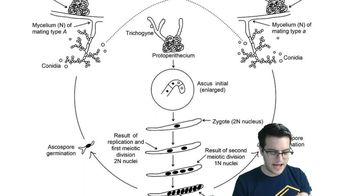
Fungi Reproduction - 3

Phenotype Frequency

Phenotype frequency refers to how common a particular trait or characteristic is within a population. While a common phenotype might suggest adaptation to the environment, it does not directly measure fitness. Fitness is more accurately assessed by reproductive success rather than the prevalence of a phenotype, as common traits may not always confer reproductive advantages.
Recommended video:
06:58
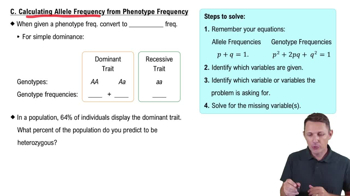
C. Calculating Allele Frequency from Phenotype Frequency
Related Practice
Textbook Question

True or false? Some traits are considered vestigial because they existed long ago.

Textbook Question

Why does the presence of extinct forms and transitional features in the fossil record support the pattern component of the theory of evolution by natural selection? Select True or False for each statement.

T/F It supports the hypothesis that individuals change over time.

T/F It supports the hypothesis that weaker species are eliminated by natural selection.

T/F It supports the hypothesis that species evolve to become more complex and better adapted over time.

T/F It supports the hypothesis that species change over time.

1
views
Textbook Question

Traits that are derived from a common ancestor, like the bones of human arms and bird wings, are said to be               .

Textbook Question

According to data presented in this chapter, which of the following are correct? Select True or False for each statement. T/F When individuals change in response to challenges from the environment, their altered traits are passed on to offspring. T/F Species are created independently of each other and do not change over time. T/F Populations—not individuals—change when natural selection occurs. T/F The traits of populations become more perfect over time.

1
views
Textbook Question

Some biologists summarize evolution by natural selection with the phrase "mutation proposes, selection disposes." Mutation is a process that creates heritable variation. Explain what the phrase means.

Textbook Question

Why don't the biggest and strongest individuals in a population always produce the most offspring?

a. The biggest and strongest individuals always have higher fitness.

b. In some environments, being big and strong lowers fitness.

c. Sometimes the biggest and strongest individuals may choose to have fewer offspring.

d. Sometimes the number of offspring is not related to fitness.