Pearson+ LogoPearson+ Logo
Ch. 2 - Water and Carbon: The Chemical Basis of Life
Freeman - Biological Science 8th Edition
Freeman8th EditionBiological ScienceISBN: 9780138276263Not the one you use?Change textbook
Chapter 2, Problem 13

Stony corals secrete thin layers of calcium carbonate (CaCO3) to build the foundation of coral reefs. The relationship between calcium carbonate, carbonic acid, and calcium bicarbonate (Ca(HCO3)2) is shown below:


CH2O3(π‘Žπ‘ž)+CaCO3(𝑠) β‡Œ Ca(HCO3)2(π‘Žπ‘ž)


Predict what will happen to the calcium carbonate foundation of reefs as CO2 levels rise in the oceans.

Verified step by step guidance
1
Understand the chemical reaction: The reaction CH2O3(aq) + CaCO3(s) β‡Œ Ca(HCO3)2(aq) shows that carbonic acid (CH2O3) reacts with calcium carbonate (CaCO3) to form calcium bicarbonate (Ca(HCO3)2).
Recognize the source of carbonic acid: Carbonic acid forms when carbon dioxide (CO2) dissolves in water. As CO2 levels in the ocean increase, more CO2 dissolves, forming more carbonic acid.
Analyze the effect on the reaction: With more carbonic acid in the ocean, the reaction is pushed to the right, according to Le Chatelier's Principle, which states that a system at equilibrium will adjust to counteract a change in conditions.
Predict the impact on calcium carbonate: As the reaction shifts to the right, more calcium carbonate (CaCO3) is converted into calcium bicarbonate (Ca(HCO3)2).
Consider the ecological consequences: The dissolution of calcium carbonate weakens the structural integrity of coral reefs, potentially leading to their degradation as CO2 levels continue to rise.

Key Concepts

Here are the essential concepts you must grasp in order to answer the question correctly.

Calcium Carbonate Chemistry

Calcium carbonate (CaCO3) is a key component of coral reefs, providing structural integrity. It can dissolve in acidic conditions, which occurs when carbon dioxide (CO2) reacts with water to form carbonic acid (H2CO3). This process can lead to the formation of bicarbonate ions (Ca(HCO3)2), impacting the availability of calcium carbonate for coral growth.
Recommended video:

Ocean Acidification

Ocean acidification refers to the decrease in pH levels of ocean water due to increased CO2 absorption. As CO2 levels rise, more carbonic acid is formed, which lowers the pH and increases the acidity of seawater. This change in acidity can hinder the ability of corals to secrete calcium carbonate, ultimately threatening the stability of coral reef ecosystems.
Recommended video:
Guided course
03:57
Seasonal Turnover & Ocean Upwelling

Coral Reef Ecosystem Dynamics

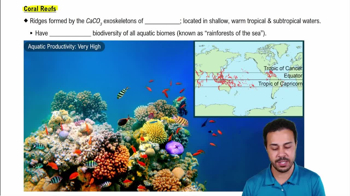
Coral reefs are complex ecosystems that rely on the balance between calcium carbonate deposition and dissolution. Healthy reefs depend on the ability of corals to build their structures through calcium carbonate secretion. Disruptions in this balance, such as those caused by rising CO2 levels, can lead to reef degradation, affecting biodiversity and the services reefs provide to marine life and human communities.
Recommended video: