
Pearson+ LogoPearson+ Logo
Ch. 18 - Control of Gene Expression in Bacteria
Freeman - Biological Science 8th Edition
Freeman8th EditionBiological ScienceISBN: 9780138276263Not the one you use?Change textbook
Chapter 18, Problem 8

IPTG is a molecule with a structure much like lactose. IPTG can be transported into cells by galactoside permease and can bind to the lac repressor protein. However, unlike lactose, IPTG is not broken down by ββ-galactosidase.
Predict what would occur to lac operon regulation if IPTG were added to E. coli growth medium containing no glucose or lactose.

Verified step by step guidance
1
Understand the lac operon: The lac operon in E. coli is a set of genes involved in lactose metabolism. It is regulated by the presence or absence of lactose and glucose. The lac repressor protein binds to the operator region of the operon, preventing transcription when lactose is absent. When lactose is present, it binds to the repressor, causing it to release the operator and allowing transcription to occur.
Recognize the role of IPTG: IPTG is an analog of lactose, meaning it mimics lactose in its ability to bind to the lac repressor protein. However, unlike lactose, IPTG is not metabolized by β-galactosidase, so its concentration remains constant in the cell once added.
Analyze the conditions: The growth medium contains no glucose or lactose, but IPTG is added. In the absence of glucose, the levels of cyclic AMP (cAMP) in the cell will increase. cAMP binds to the catabolite activator protein (CAP), forming a cAMP-CAP complex that enhances transcription of the lac operon by binding to the promoter region.
Predict the effect of IPTG: IPTG will bind to the lac repressor protein, causing it to release the operator region. This derepression allows RNA polymerase to access the promoter and initiate transcription of the lac operon genes. Since IPTG is not broken down, the operon will remain active as long as IPTG is present.
Summarize the outcome: In the absence of glucose and lactose, the addition of IPTG will lead to the activation of the lac operon. The genes for lactose metabolism (including β-galactosidase and galactoside permease) will be transcribed and translated, even though lactose is not present, because IPTG acts as a non-metabolizable inducer.

Verified video answer for a similar problem:

This video solution was recommended by our tutors as helpful for the problem above.
Video duration:
4m
Was this helpful?

Key Concepts

Here are the essential concepts you must grasp in order to answer the question correctly.

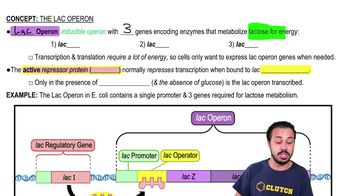
Lac Operon

The lac operon is a set of genes in E. coli that are responsible for the metabolism of lactose. It consists of structural genes that encode proteins necessary for lactose uptake and breakdown, regulated by a promoter and an operator. When lactose is present, it binds to the lac repressor, allowing transcription of the operon. Understanding this system is crucial for predicting how IPTG, a lactose analog, will affect gene expression.
Recommended video:
Guided course
07:06
The Lac Operon

IPTG and its Role

IPTG (Isopropyl β-D-1-thiogalactopyranoside) is a synthetic molecule that mimics lactose but is not metabolized by E. coli. It can bind to the lac repressor protein, causing it to release from the operator region of the lac operon, thus promoting transcription. This property makes IPTG a valuable tool in molecular biology for inducing gene expression in recombinant DNA technology.
Recommended video:
Guided course
02:36
Cerebellum and Brainstem

Galactoside Permease

Galactoside permease is a membrane protein that facilitates the transport of galactosides, such as lactose and IPTG, into E. coli cells. Its function is essential for the uptake of these sugars, which is the first step in the utilization of lactose. In the absence of glucose, the presence of IPTG would lead to the activation of the lac operon, allowing for the expression of genes involved in lactose metabolism.
Related Practice
Textbook Question

Evaluate these statements about regulation of the lac operon. Select True or False for each statement.

T/FThe lac operon is transcribed at the highest rate when extracellular glucose and lactose are abundant.

T/FThe repressor protein is bound to DNA of the operator when lactose is present.

T/FA mutation in the operator is likely to prevent transcription of the lac operon under any condition.

T/FA mutation that alters the catabolite activator protein is predicted to alter the regulation of many different operons.

1
views
Textbook Question

Predict what would happen to regulation of the lac operon if the lacI gene were moved 50,000 nucleotides upstream of its normal location.

Textbook Question

Explain why it makes sense for the lexA regulatory gene of the SOS regulon to be expressed constitutively.

Textbook Question

In a mutant that lacks adenylyl cyclase, the enzyme that synthesizes cAMP, predict which of the following conditions of extracellular lactose and glucose would cause regulation of the lac operon to differ from that of wild-type cells.

a. No lactose, no glucose

b. No lactose, abundant glucose

c. Abundant lactose, no glucose

d. Abundant lactose, abundant glucose

Textbook Question

X-gal is a colorless, lactose-like molecule that can be split into two fragments by ββ-galactosidase. One of these product molecules creates a blue color. The photograph here shows E. coli colonies growing in a medium that contains X-gal. Find three colonies whose cells have functioning copies of ββ-galactosidase.

Find three colonies whose cells might have mutations in the lacZ or the lacY genes.

Suppose you analyze the protein-coding sequence of the lacZ and lacY genes of cells from the three mutant colonies and find that these sequences are wild type (normal).

What other region of the lac operon might be altered to account for the mutant phenotype of these colonies?

Textbook Question

The Hawaiian bobtail squid (Euprymna scolopes) is able to glow from luminescent Vibrio fischeri bacteria held in its light organs. As it swims at night near the ocean surface, it adjusts the amount of light visible to predators below to match the light from the stars and moon. Predators have difficulty seeing the illuminated squid against the night sky.

The bacteria glow in response to a molecule that regulates expression of genes involved in light-producing chemical reactions. The regulator controls production of the genes' mRNA. Therefore, the light-producing genes are under

a. Transcriptional control.

b. Translational control.

c. Post-translational control.

d. Negative control.