Pearson+ LogoPearson+ Logo
Ch. 17 - Transcription, RNA Processing, and Translation
Freeman - Biological Science 8th Edition
Freeman8th EditionBiological ScienceISBN: 9780138276263Not the one you use?Change textbook
Chapter 17, Problem 15

<Image>
Eating even a single death cap mushroom (Amanita phalloides) can be fatal due to a compound called α-amanitin, a toxin that inhibits transcription.
Biologists have investigated how fast pre-mRNA splicing occurs by treating cells with a toxin that blocks the production of new pre-mRNAs, then following the rate of splicing of the pre-mRNAs that were transcribed before adding the toxin. Why is addition of a toxin important in this study?

Verified step by step guidance
1
Understand the process of pre-mRNA splicing: Pre-mRNA splicing is the process by which introns (non-coding regions) are removed from pre-mRNA, and exons (coding regions) are joined together to form mature mRNA. This is a critical step in gene expression.
Recognize the role of the toxin: The toxin is used to block the production of new pre-mRNAs. This ensures that the researchers are only observing the splicing of pre-mRNAs that were already transcribed before the toxin was added, rather than new pre-mRNAs being produced during the experiment.
Identify the importance of isolating the splicing process: By halting the production of new pre-mRNAs, the researchers can focus solely on the rate of splicing of the existing pre-mRNAs. This eliminates confounding variables, such as the continuous synthesis of new pre-mRNAs, which could interfere with accurate measurement of splicing rates.
Consider the experimental design: The addition of the toxin creates a controlled environment where the only variable being measured is the splicing rate of pre-existing pre-mRNAs. This allows for precise and reliable data collection.
Conclude the significance: The use of the toxin is crucial for isolating the splicing process and ensuring that the results of the study accurately reflect the rate of pre-mRNA splicing, without interference from ongoing transcription.

Verified video answer for a similar problem:

This video solution was recommended by our tutors as helpful for the problem above.
Video duration:
2m
Was this helpful?

Key Concepts

Here are the essential concepts you must grasp in order to answer the question correctly.

pre-mRNA Splicing

Pre-mRNA splicing is a crucial process in eukaryotic gene expression where introns (non-coding regions) are removed from the pre-mRNA transcript, and exons (coding regions) are joined together. This modification is essential for producing mature mRNA that can be translated into proteins. Understanding the splicing mechanism helps researchers determine how gene expression is regulated and how it can be affected by various factors.
Recommended video:
Guided course
08:44
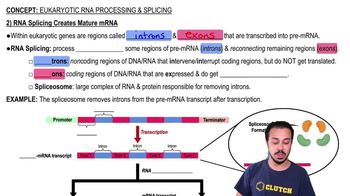
2) RNA Splicing Creates Mature mRNA

Toxin's Role in Experimental Design

In this study, the toxin serves as a tool to halt the production of new pre-mRNAs, allowing researchers to focus on the splicing of pre-mRNAs that were already present in the cells. This controlled environment is critical for accurately measuring the splicing rate without the confounding effects of newly synthesized transcripts, thereby providing clearer insights into the dynamics of the splicing process.
Recommended video:
Guided course
02:50
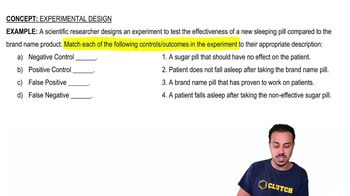
Experimental Design Example 1

Rate of Splicing

The rate of splicing refers to how quickly pre-mRNA is processed into mature mRNA. This rate can be influenced by various factors, including the presence of splicing factors, the structure of the pre-mRNA, and external conditions such as the introduction of toxins. By measuring this rate, biologists can gain insights into the efficiency and regulation of gene expression, which is vital for understanding cellular function and response to environmental changes.
Recommended video:
Guided course
02:32
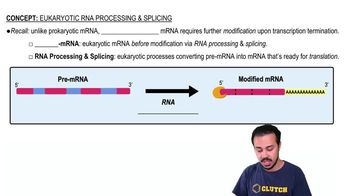
Eukaryotic RNA Processing and Splicing
Related Practice
Textbook Question

<Image>

Eating even a single death cap mushroom (Amanita phalloides) can be fatal due to a compound called α-amanitin, a toxin that inhibits transcription.

α-Amanitin inhibits transcription by binding inside an RNA polymerase to a region other than the active site that catalyzes addition of a nucleotide to the RNA chain. Based on the model of RNA polymerase shown in Figure 17.3, predict how the toxin might function to inhibit transcription.

3
views
Textbook Question

<Image>

Eating even a single death cap mushroom (Amanita phalloides) can be fatal due to a compound called α-amanitin, a toxin that inhibits transcription.

Toxins like α-amanitin are used for research in much the same way as null mutants (Chapter 16)—to disrupt a process and see what happens when it no longer works. Researchers examined the ability of α-amanitin to inhibit different RNA polymerases. They purified RNA polymerases I, II, and III from rat liver, incubated the enzymes with different concentrations of α-amanitin, and then tested their activity. The results of this experiment are shown here. These findings suggest that cells treated with α-amanitin will have a reduced level of:

a. tRNAs

b. rRNAs

c. snRNAs

d. mRNAs

Textbook Question

<Image>

Eating even a single death cap mushroom (Amanita phalloides) can be fatal due to a compound called α-amanitin, a toxin that inhibits transcription.

If you wanted to use α-amanitin to shut down 95 percent of transcription by RNA polymerase II, roughly what concentration of α-amanitin would you use? Note that the scale on the x-axis of the graph in Question 13 is logarithmic rather than linear, so that each tick mark shows a tenfold higher concentration.

Textbook Question

<Image>

Eating even a single death cap mushroom (Amanita phalloides) can be fatal due to a compound called α-amanitin, a toxin that inhibits transcription.

The primary cause of death from α-amanitin poisoning is liver failure. Suppose a physician informs you that liver cells die because their rate of protein production falls below a level needed to maintain active metabolism. Given that α-amanitin is an inhibitor of transcription, you wonder if this information is correct. Propose an experiment to determine whether the toxin also has an effect on protein synthesis.