If a base-pair change occurs in DNA, this a. is a mutation. b. would be a mutation only if it falls in a protein-coding part of a gene. c. would be a mutation only if it falls in a transcribed part of the genome. d. is not a mutation, because only one base pair has been altered.
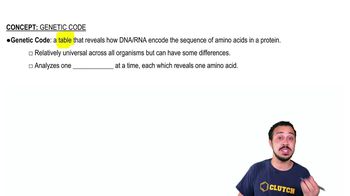
Which of the following describes the experimental strategy that was used to decipher the genetic code?
a. Comparing the amino acid sequences of proteins with the base sequence of their genes
b. Analyzing the sequence of RNAs produced from known DNA sequences
c. Analyzing mutants that changed the code
d. Examining the polypeptides produced when RNAs with particular sequences were translated
Verified step by step guidance
Verified video answer for a similar problem:
Key Concepts
Genetic Code
Transcription and Translation
Mutagenesis
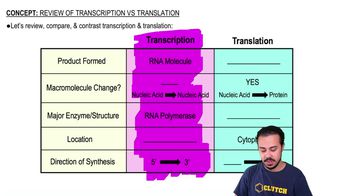
Which of the following is an important exception to the central dogma of molecular biology?
a. Many genes code for RNAs that function directly in the cell.
b. DNA is the repository of genetic information in all cells.
c. Messenger RNA is a short-lived 'information carrier.
d. Proteins are responsible for most aspects of the phenotype.
DNA's primary structure is made up of just four different bases, and its secondary structure is regular and highly stable. How can a molecule with these characteristics hold the information required to build and maintain a cell?
A friend says, 'Geneticists spend all their time talking about DNA, but that's silly because DNA really isn't that important in the functions of a cell.' In what ways is she right, and in what ways might she be wrong?
A minimal genetic code requires only 21 codons—one for each amino acid, and one for a stop signal. Given this, what advantage might be offered by having a code with 64 codons?
Which of the following describes mutations? Select True or False for each statement.
T/F Point mutations can occur in any DNA sequence.
T/F Frameshift mutations can occur in any DNA sequence.
T/F Neutral mutations depend on the degeneracy of the genetic code.
T/F Deleterious mutations occur only in protein-coding sequences of DNA.
