Pearson+ LogoPearson+ Logo
Ch. 14 - Mendel and the Gene
Freeman - Biological Science 8th Edition
Freeman8th EditionBiological ScienceISBN: 9780138276263Not the one you use?Change textbook
Chapter 14, Problem 14

The blending inheritance hypothesis proposed that the genetic material from parents is mixed in the offspring. As a result, traits of offspring and later descendants should lie between the phenotypes of parents. Mendel, in contrast, proposed that genes are discrete and that their integrity is maintained in the offspring and in subsequent generations. Suppose the year is 1890. You are a horse breeder who has just read Mendel's paper. You don't believe his results, however, because you often work with cremello (very light-colored) and chestnut (reddish-brown) horses. You know that when you breed a cremello individual from a pure-breeding line with a chestnut individual from a pure-breeding line, the offspring are palomino—meaning they have an intermediate (golden-yellow) body color. What additional cross would you do to test whether Mendel's model is valid in the case of genes for horse color? According to his model, what offspring phenotype frequencies would you get from your experimental cross? Explain why your cross would test Mendel's model versus blending inheritance.

Verified step by step guidance
1
Step 1: Understand the problem. The problem is asking you to design an experiment to test Mendel's model of inheritance versus the blending inheritance hypothesis. You are given that when a cremello horse is bred with a chestnut horse, the offspring are palomino, which is an intermediate color. This seems to support the blending inheritance hypothesis. However, you want to test if Mendel's model could still be valid.
Step 2: Design the experiment. To test Mendel's model, you would need to perform a cross that could potentially produce offspring with the parental phenotypes (cremello and chestnut). A good choice would be to cross two of the palomino offspring with each other. According to Mendel's model, this should produce some offspring with the parental phenotypes.
Step 3: Predict the results. According to Mendel's model, the cross of two palomino horses should produce offspring in a 1:2:1 ratio of cremello:palomino:chestnut. This is because the palomino horses are heterozygous, carrying one allele for cremello and one for chestnut. When these alleles segregate during meiosis, each gamete will carry one allele. The combination of these alleles in the offspring will determine their color.
Step 4: Explain why this tests Mendel's model. This cross tests Mendel's model because it allows for the possibility of the parental phenotypes reappearing in the offspring. According to the blending inheritance hypothesis, once the parental traits have been mixed, they cannot be separated out again. Therefore, if the parental phenotypes do appear in the offspring, this would support Mendel's model over the blending inheritance hypothesis.
Step 5: Perform the experiment. To confirm your hypothesis, you would need to actually perform the cross and observe the results. If the results match your prediction, this would provide evidence in support of Mendel's model. If not, it would suggest that the blending inheritance hypothesis may be more accurate in this case.

Verified video answer for a similar problem:

This video solution was recommended by our tutors as helpful for the problem above.
Video duration:
1m
Was this helpful?

Key Concepts

Here are the essential concepts you must grasp in order to answer the question correctly.

Mendelian Inheritance

Mendelian inheritance refers to the principles of heredity established by Gregor Mendel, which state that traits are determined by discrete units called genes. These genes segregate independently during gamete formation, ensuring that offspring inherit one allele from each parent. This model contrasts with blending inheritance, as it maintains the integrity of traits across generations rather than mixing them.
Recommended video:
Guided course
02:27
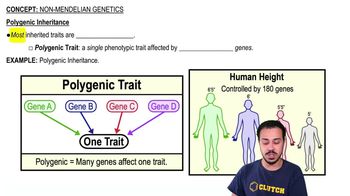
Polygenic Inheritance

Phenotype and Genotype

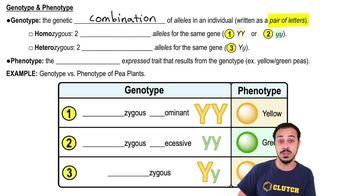
Phenotype is the observable physical or biochemical characteristics of an organism, determined by both genetic makeup (genotype) and environmental influences. In the context of horse color, the phenotype includes colors like cremello, chestnut, and palomino, while the genotype refers to the specific alleles that dictate these colors. Understanding the relationship between genotype and phenotype is crucial for predicting the outcomes of genetic crosses.
Recommended video:
Guided course
06:36
Genotype & Phenotype

Test Cross

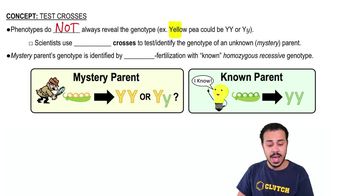
A test cross is a breeding experiment used to determine the genotype of an individual exhibiting a dominant phenotype. By crossing this individual with a homozygous recessive individual, one can observe the phenotypes of the offspring to infer the unknown genotype. In this case, crossing a palomino horse with a chestnut horse would help determine if the palomino's genotype is heterozygous or homozygous, thus testing Mendel's model against the blending inheritance hypothesis.
Recommended video:
Related Practice
Textbook Question

Suppose you are heterozygous for two genes that are located on different chromosomes. You carry alleles A and a for one gene and alleles B and b for the other. Label the stages of meiosis, the homologous chromosomes, sister chromatids, nonhomologous chromosomes, genes, and alleles.

1
views
Textbook Question

Suppose you are heterozygous for two genes that are located on different chromosomes. You carry alleles A and a for one gene and alleles B and b for the other. Be sure to list all the genetically different gametes that could form and indicate how frequently each type should be observed.

Textbook Question

Suppose you are heterozygous for two genes that are located on different chromosomes. You carry alleles A and a for one gene and alleles B and b for the other. On the diagram, identify the events responsible for the principle of segregation and the principle of independent assortment.

Textbook Question

Two mothers give birth to sons at the same time in a busy hospital. The son of couple 1 is afflicted with hemophilia A, which is a recessive X-linked disease. Neither parent has the disease. Couple 2 has a normal son even though the father has hemophilia A. The two couples sue the hospital in court, claiming that a careless staff member swapped their babies at birth. You appear in court as an expert witness. What do you tell the jury? Make a diagram that you can submit to the jury.

Textbook Question

You have crossed two Drosophila melanogaster individuals that have long wings and red eyes—the wild-type phenotype. In the progeny, curved wings and lozenge eyes mutant phenotypes appear as follows According to these data, is the curved-wing allele autosomal recessive, autosomal dominant, sex-linked recessive, or sex-linked dominant?

Textbook Question

You have crossed two Drosophila melanogaster individuals that have long wings and red eyes—the wild-type phenotype. In the progeny, curved wings and lozenge eyes mutant phenotypes appear as follows. Is the lozenge-eyed allele autosomal recessive, autosomal dominant, sex-linked recessive, or sex-linked dominant?