Pearson+ LogoPearson+ Logo
Ch. 14 - Mendel and the Gene
Freeman - Biological Science 8th Edition
Freeman8th EditionBiological ScienceISBN: 9780138276263Not the one you use?Change textbook
Chapter 14, Problem 8c

In garden peas, yellow seeds (Y) are dominant to green seeds (y), and inflated pods (I) are dominant to constricted pods (i). Suppose you have crossed YYII parents with yyii parents. Draw the F2 Punnett square. Based on this Punnett square, predict the expected phenotype(s) in the F2 generation and the expected frequency of each phenotype.

Verified step by step guidance
1
insert step 1
insert step 2
insert step 3
insert step 4
insert step 5

Verified video answer for a similar problem:

This video solution was recommended by our tutors as helpful for the problem above.
Video duration:
1m
Was this helpful?

Key Concepts

Here are the essential concepts you must grasp in order to answer the question correctly.

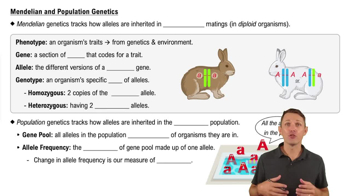
Mendelian Genetics

Mendelian genetics is the study of how traits are inherited through generations based on the principles established by Gregor Mendel. It involves understanding dominant and recessive alleles, where dominant traits mask the expression of recessive ones. In this case, yellow seeds (Y) and inflated pods (I) are dominant traits, while green seeds (y) and constricted pods (i) are recessive.
Recommended video:
04:26
Mendelian and Population Genetics

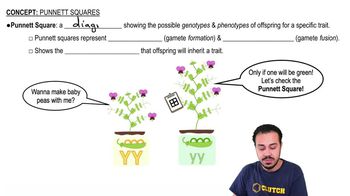
Punnett Square

A Punnett square is a diagram used to predict the genotypic and phenotypic outcomes of a genetic cross. It organizes the possible combinations of alleles from each parent, allowing for the visualization of potential offspring traits. In this scenario, the F1 generation from crossing YYII and yyii will all be YyIi, and the F2 generation can be analyzed by crossing these F1 individuals.
Recommended video:
Guided course
01:37
Punnett Squares

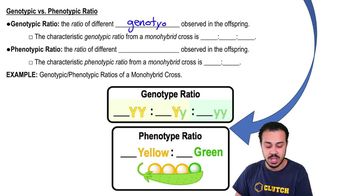
Phenotypic Ratios

Phenotypic ratios represent the relative frequencies of different phenotypes in the offspring resulting from a genetic cross. After constructing the F2 Punnett square, one can determine the expected phenotypes and their ratios, such as the proportion of yellow vs. green seeds and inflated vs. constricted pods. This analysis helps predict how traits will be expressed in the next generation.
Recommended video:
Guided course
02:48
Genotypic vs. Phenotypic Ratio
Related Practice
Textbook Question

In flies, small wings are recessive to normal wings. If a cross between two flies produces 8 small-wing offspring and 28 normal-wing offspring, what are the most likely genotypes of the parents? (Use S to represent the normal-wing allele and s to represent the short-wing allele.)

Textbook Question

In garden peas, yellow seeds (Y) are dominant to green seeds (y), and inflated pods (I) are dominant to constricted pods (i). Suppose you have crossed YYII parents with yyii parents. Draw the F1 Punnett square and predict the expected F1 phenotype(s).

Textbook Question

In garden peas, yellow seeds (Y) are dominant to green seeds (y), and inflated pods (I) are dominant to constricted pods (i). Suppose you have crossed YYII parents with yyii parents. List the genotype(s) of gametes produced by F1 individuals.

Textbook Question

In parakeets, two autosomal genes that are located on different chromosomes control the production of feather pigment. Gene B codes for an enzyme that is required for the synthesis of a blue pigment, and gene Y codes for an enzyme required for the synthesis of a yellow pigment. Green results from a mixture of yellow and blue pigments, and recessive mutations that prevent production of either pigment are known for both genes. Suppose that a breeder has two green parakeets and mates them. The offspring are green, blue, yellow, and albino (unpigmented).

Based on this observation, what are the genotypes of the green parents?

What genotypes produce each color in the offspring? What fraction of the progeny should exhibit each type of color?
Textbook Question

The smooth feathers on the back of the neck in pigeons can be reversed by a mutation to produce a 'crested' appearance in which feathers form a distinctive spike at the back of the head. A pigeon breeder examined offspring produced by a single pair of non-crested birds and recorded the following: 22 non-crested and 7 crested. She then made a series of crosses using offspring from the first cross. When she crossed two of the crested birds, all 20 of the offspring were crested. When she crossed a non-crested bird with a crested bird, 7 offspring were non-crested and 6 were crested. For these three crosses, provide genotypes for parents and offspring that are consistent with these results.

Textbook Question

The smooth feathers on the back of the neck in pigeons can be reversed by a mutation to produce a 'crested' appearance in which feathers form a distinctive spike at the back of the head. A pigeon breeder examined offspring produced by a single pair of non-crested birds and recorded the following: 22 non-crested and 7 crested. She then made a series of crosses using offspring from the first cross. When she crossed two of the crested birds, all 20 of the offspring were crested. When she crossed a non-crested bird with a crested bird, 7 offspring were non-crested and 6 were crested. Which allele is dominant?