Pearson+ LogoPearson+ Logo
Ch. 12 - The Cell Cycle
Freeman - Biological Science 8th Edition
Freeman8th EditionBiological ScienceISBN: 9780138276263Not the one you use?Change textbook
Chapter 12, Problem 10

When a fruit fly embryo first begins to develop, a large cell is generated that contains over 8000 genetically identical nuclei. What is most likely responsible for this result?

Verified step by step guidance
1
Understand the context: The problem describes the early development of a fruit fly embryo, where a single large cell contains over 8000 genetically identical nuclei. This suggests rapid nuclear division without cell division, a process known as syncytial division.
Recall the concept of mitosis: Mitosis is the process by which a cell divides its nucleus to produce two genetically identical nuclei. In this case, mitosis occurs repeatedly without cytokinesis (the physical division of the cell).
Identify the mechanism: Syncytial division involves multiple rounds of nuclear division within a shared cytoplasm. This allows the nuclei to remain genetically identical because they are derived from the same original nucleus through mitosis.
Consider the role of the cell cycle: During syncytial division, the cell cycle progresses through the stages of mitosis (prophase, metaphase, anaphase, and telophase) but skips cytokinesis, resulting in a single cell with many nuclei.
Relate this to embryonic development: In fruit fly embryos, syncytial division is an efficient way to rapidly produce many nuclei, which later become partitioned into individual cells during cellularization, supporting the development of the organism.

Verified video answer for a similar problem:

This video solution was recommended by our tutors as helpful for the problem above.
Video duration:
1m
Was this helpful?

Key Concepts

Here are the essential concepts you must grasp in order to answer the question correctly.

Nuclear Division

Nuclear division, specifically mitosis, is the process by which a cell divides its nucleus and genetic material. In the case of the fruit fly embryo, multiple rounds of mitosis occur without cytokinesis, leading to a syncytium—a single cell with multiple nuclei. This allows for rapid cell division and the formation of a large cell containing genetically identical nuclei.
Recommended video:
Guided course
03:19
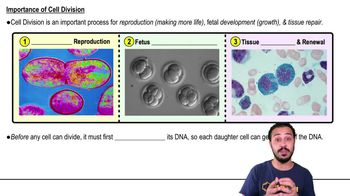
Importance of Cell Division

Syncytium Formation

Syncytium formation occurs when multiple nuclei share a common cytoplasm without the separation of the cell membrane. In fruit fly embryos, this process is crucial during early development, as it enables the rapid accumulation of nuclei in a single cell, facilitating efficient resource allocation and developmental signaling before individual cell membranes form.
Recommended video:
Guided course
03:08
Formation & Breakdown of Polysaccharides

Genetic Identity in Embryonic Development

During early embryonic development, cells often undergo divisions that maintain genetic identity, meaning that all nuclei produced are genetically identical to the original zygote. This genetic uniformity is essential for coordinated development, as it ensures that all cells in the syncytium share the same genetic instructions, which is vital for proper embryonic patterning and differentiation later in development.
Recommended video:
Guided course
06:02
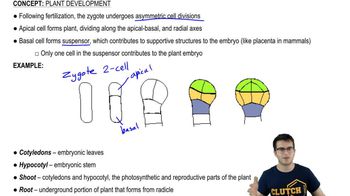
Embryonic Plant Development