Pearson+ LogoPearson+ Logo
Ch. 10 - Photosynthesis
Freeman - Biological Science 8th Edition
Freeman8th EditionBiological ScienceISBN: 9780138276263Not the one you use?Change textbook
Chapter 10, Problem 10

An investigator exposes chloroplasts to 700-nm photons and observes low O2 production, but high ATP production. Which of the following best explains this observation?
a. The electrons from water are directly transferred to NADP+, which is used to generate ATP.
b. Photosystem II is not splitting water, and the ATP is being produced by cycling electrons via photosystem I.
c. The O2 is being converted to water as a terminal electron acceptor in the production of ATP.
d. Electron transport has stopped and ATP is being produced by the Calvin cycle.

Verified step by step guidance
1
Understand the role of photosystems in photosynthesis: Photosystem II (PSII) is responsible for splitting water molecules to release oxygen (O2), electrons, and protons. Photosystem I (PSI) is primarily involved in the production of NADPH and can also contribute to ATP production through cyclic electron flow.
Analyze the wavelength of light: The 700-nm photons correspond to the absorption peak of Photosystem I (PSI), not Photosystem II (PSII). This suggests that PSI is active, while PSII might not be effectively engaged.
Consider the implications of low O2 production: Low oxygen production indicates that water splitting by PSII is not occurring efficiently. This suggests that PSII is not functioning optimally or is bypassed.
Evaluate ATP production: High ATP production in the absence of significant O2 production suggests that ATP is being generated through cyclic photophosphorylation, a process where electrons are cycled back to PSI, allowing for ATP synthesis without the production of NADPH or O2.
Conclude the explanation: The observation of low O2 but high ATP production is best explained by the fact that Photosystem II is not splitting water, and ATP is being produced by cycling electrons via Photosystem I, which aligns with option b.

Verified video answer for a similar problem:

This video solution was recommended by our tutors as helpful for the problem above.
Video duration:
5m
Was this helpful?

Key Concepts

Here are the essential concepts you must grasp in order to answer the question correctly.

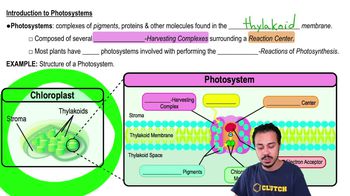
Photosystems in Photosynthesis

Photosynthesis involves two main photosystems: Photosystem I (PSI) and Photosystem II (PSII). PSII absorbs light at 680 nm and is responsible for splitting water molecules to release oxygen. PSI absorbs light at 700 nm and primarily facilitates the production of NADPH. Understanding the roles of these photosystems is crucial for explaining the observed phenomena in the question.
Recommended video:
Guided course
04:59
Introduction to Photosystems

Cyclic Electron Flow

Cyclic electron flow is a process in photosynthesis where electrons are recycled around Photosystem I, leading to the production of ATP without the generation of NADPH or oxygen. This process is significant when PSII is inactive or when the plant requires more ATP than NADPH, explaining the high ATP production and low O2 output in the scenario described.
Recommended video:
01:43
Gene Flow

Role of Water in Photosynthesis

Water is a crucial electron donor in photosynthesis, particularly in Photosystem II, where it is split to release oxygen, electrons, and protons. If PSII is not functioning, as suggested in the question, water is not split, resulting in low oxygen production. This concept helps clarify why O2 levels remain low despite active ATP synthesis.
Recommended video:
Guided course
03:32
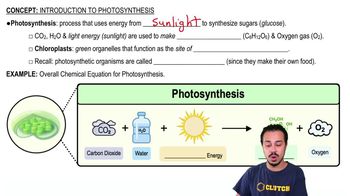
Introduction to Photosynthesis