Pearson+ LogoPearson+ Logo
Ch. 50 - Sensory and Motor Mechanisms
Campbell - Campbell Biology 11th Edition
Urry11th EditionCampbell BiologyISBN: 9789357423311Not the one you use?Change textbook
Chapter 50, Problem 3

During the contraction of a vertebrate skeletal muscle fiber, calcium ions
a. Break cross-bridges as a cofactor in hydrolysis of ATP
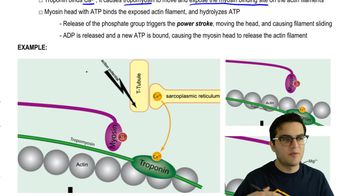
b. Bind with troponin, changing its shape so that the myosin-binding sites on actin are exposed
c. Transmit action potentials from the motor neuron to the muscle fiber
d. Spread action potentials through the T tubules

Verified step by step guidance
1
Understand the role of calcium ions in muscle contraction: Calcium ions play a crucial role in the process of muscle contraction by interacting with specific proteins within the muscle fibers.
Identify the proteins involved: In skeletal muscle fibers, the proteins troponin and tropomyosin regulate the interaction between actin and myosin, which are essential for muscle contraction.
Recognize the function of troponin: Troponin is a complex of three proteins that binds to calcium ions. When calcium ions bind to troponin, it causes a conformational change.
Explain the exposure of myosin-binding sites: The conformational change in troponin moves tropomyosin away from the myosin-binding sites on actin filaments, allowing myosin heads to bind to actin and initiate contraction.
Conclude the correct option: Based on the understanding of calcium's role in muscle contraction, the correct answer is that calcium ions bind with troponin, changing its shape so that the myosin-binding sites on actin are exposed.

Verified video answer for a similar problem:

This video solution was recommended by our tutors as helpful for the problem above.
Video duration:
3m
Was this helpful?

Key Concepts

Here are the essential concepts you must grasp in order to answer the question correctly.

Calcium Ions in Muscle Contraction

Calcium ions play a crucial role in muscle contraction by binding to troponin, a regulatory protein associated with the actin filament. This binding causes a conformational change in troponin, which moves tropomyosin away from the myosin-binding sites on actin, allowing cross-bridge formation between actin and myosin, leading to muscle contraction.
Recommended video:
Guided course
02:40
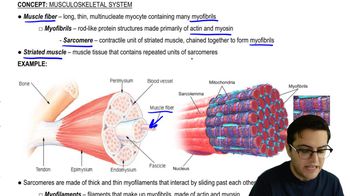
Muscle Fibers and Sarcomeres

Troponin and Tropomyosin

Troponin is a complex of three proteins that regulate muscle contraction by controlling the position of tropomyosin on the actin filament. When calcium ions bind to troponin, it alters its shape, shifting tropomyosin to expose the myosin-binding sites on actin, facilitating the interaction necessary for muscle contraction.
Recommended video:
Guided course
04:30
Sliding Filament Model

T Tubules and Action Potentials

T tubules are invaginations of the muscle cell membrane that play a key role in transmitting action potentials deep into the muscle fiber. This transmission ensures that the signal for contraction reaches all parts of the muscle fiber simultaneously, triggering the release of calcium ions from the sarcoplasmic reticulum, which is essential for muscle contraction.
Recommended video:
Guided course
09:55
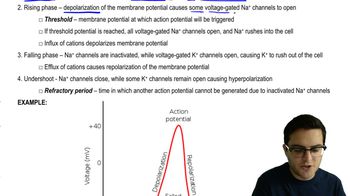
Action Potential