Pearson+ LogoPearson+ Logo
Ch. 34 - The Origin and Evolution of Vertebrates
Campbell - Campbell Biology 11th Edition
Urry11th EditionCampbell BiologyISBN: 9789357423311Not the one you use?Change textbook
Chapter 34, Problem 4

Which clade does not include humans?
a. Synapsids
b. Lobe-fins
c. Diapsids
d. Osteichthyans

Verified step by step guidance
1
Understand the concept of clades: A clade is a group of organisms that includes a common ancestor and all its descendants. Clades are used in phylogenetics to show evolutionary relationships.
Identify the clades mentioned in the problem: synapsids, lobe-fins, diapsids, and osteichthyans.
Recall the evolutionary lineage of humans: Humans belong to the clade of synapsids, which includes mammals and their ancestors.
Examine the clade of lobe-fins: Lobe-fins include tetrapods, which are vertebrates with limbs, and humans are part of this clade.
Consider the clade of diapsids: Diapsids are a group of reptiles that include birds, crocodiles, and lizards. Humans are not part of this clade.

Verified video answer for a similar problem:

This video solution was recommended by our tutors as helpful for the problem above.
Video duration:
27s
Was this helpful?

Key Concepts

Here are the essential concepts you must grasp in order to answer the question correctly.

Clade

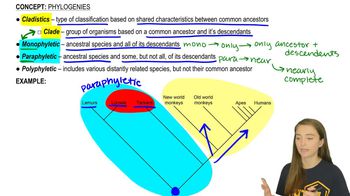
A clade is a group of organisms that includes a common ancestor and all its descendants, representing a single branch on the tree of life. Understanding clades helps in tracing evolutionary relationships and determining which organisms share a common lineage.
Recommended video:

Synapsids

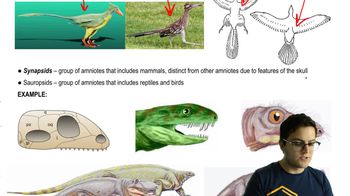
Synapsids are a clade of animals that includes mammals and their extinct relatives. They are characterized by having a single temporal opening in the skull. Humans, as mammals, are part of the synapsid clade, which is crucial for understanding our evolutionary history.
Recommended video:
Guided course
04:14
Birds and Synapsids

Diapsids

Diapsids are a clade of reptiles that have two temporal openings in their skulls. This group includes most reptiles and birds, but not mammals. Understanding diapsids is essential for identifying clades that do not include humans, as humans belong to the synapsid clade.
Related Practice
Textbook Question

Vertebrates and tunicates share

a. Jaws adapted for feeding

b. A high degree of cephalization

c. An endoskeleton that includes a skull

d. A notochord and a dorsal, hollow nerve cord

Textbook Question

Living vertebrates can be divided into two major clades. Select the appropriate pair.

a. The chordates and the tetrapods

b. The urochordates and the cephalochordates

c. The cyclostomes and the gnathostome

d. The marsupials and the eutherians

1
views
Textbook Question

Unlike eutherians, both monotremes and marsupials

a. Lack nipples

b. Have some embryonic development outside the uterus

c. Lay eggs

d. Are found in Australia and Africa

2
views
Textbook Question

As hominins diverged from other primates, which of the following appeared first?

a. Reduced jawbones

b. An enlarged brain

c. The making of stone tools

d. Bipedal locomotion

Textbook Question

Which of the following could be considered the most recent common ancestor of living tetrapods?

a. A sturdy-finned, shallow-water lobe-fin whose appendages had skeletal supports similar to those of terrestrial vertebrates

b. An armored, jawed placoderm with two pairs of appendages

c. An early ray-finned fish that developed bony skeletal supports in its paired fins

d. A salamander that had legs supported by a bony skeleton but moved with the side-to-side bending typical of fishes

Textbook Question

Living members of a vertebrate lineage can be very different from early members of the lineage, and evolutionary reversals (character losses) are common. Give examples that illustrate these observations, and explain their evolutionary causes.