Pearson+ LogoPearson+ Logo
Ch. 34 - The Origin and Evolution of Vertebrates
Campbell - Campbell Biology 11th Edition
Urry11th EditionCampbell BiologyISBN: 9789357423311Not the one you use?Change textbook
Chapter 34, Problem 7

Living members of a vertebrate lineage can be very different from early members of the lineage, and evolutionary reversals (character losses) are common. Give examples that illustrate these observations, and explain their evolutionary causes.

Verified step by step guidance
1
Start by understanding the concept of evolutionary reversals, which refers to the loss of a trait that was present in an ancestor. This can occur due to changes in environmental pressures or genetic mutations.
Consider the example of whales, which are part of the vertebrate lineage. Early ancestors of whales were land-dwelling mammals with limbs adapted for walking. Over time, whales evolved to live in aquatic environments, losing their hind limbs as they adapted to swimming.
Another example is the loss of sight in cave-dwelling fish. These fish evolved from ancestors that had functional eyes, but due to living in dark environments where sight is unnecessary, they lost their eyesight over generations.
Discuss the evolutionary causes behind these reversals. Natural selection plays a key role, where traits that are not beneficial in a given environment may be lost over time. Genetic drift can also contribute to the loss of traits, especially in small populations.
Explain how these examples illustrate the dynamic nature of evolution, where organisms continuously adapt to their environments, sometimes resulting in the loss of previously advantageous traits. This highlights the non-linear path of evolutionary change.

Verified video answer for a similar problem:

This video solution was recommended by our tutors as helpful for the problem above.
Video duration:
1m
Was this helpful?

Key Concepts

Here are the essential concepts you must grasp in order to answer the question correctly.

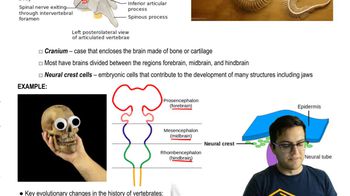
Vertebrate Lineage

A vertebrate lineage refers to the evolutionary history and development of vertebrates, which are animals with a backbone. This lineage includes diverse groups such as fish, amphibians, reptiles, birds, and mammals. Over time, these groups have evolved distinct characteristics, adapting to various environments and ecological niches.
Recommended video:

Evolutionary Reversals

Evolutionary reversals, or character losses, occur when a species reverts to an ancestral trait, losing a derived characteristic. This can happen due to changes in environmental pressures or genetic mutations. An example is the loss of limbs in snakes, which evolved from lizard-like ancestors, adapting to a burrowing lifestyle where limbs were unnecessary.
Recommended video:
02:45
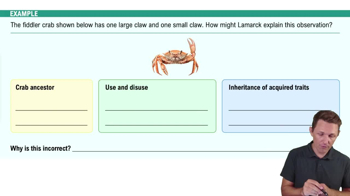
History of Evolutionary Theory Example 1

Evolutionary Causes

Evolutionary changes, including reversals, are driven by natural selection, genetic drift, and mutations. These mechanisms can lead to adaptations that enhance survival and reproduction in specific environments. For instance, the streamlined body of whales evolved from land-dwelling mammals, adapting to aquatic life by losing hind limbs and developing flippers.
Recommended video:
02:45
History of Evolutionary Theory Example 1