
Pearson+ LogoPearson+ Logo
Ch. 28 - Protists
Campbell - Campbell Biology 11th Edition
Urry11th EditionCampbell BiologyISBN: 9789357423311Not the one you use?Change textbook
Chapter 28, Problem 1

Plastids that are surrounded by more than two membranes are evidence of
a. Evolution from mitochondria.
b. Fusion of plastids.
c. Origin of the plastids from archaea.
d. Secondary endosymbiosis.

Verified step by step guidance
1
Understand the concept of plastids: Plastids are organelles found in the cells of plants and algae, primarily involved in photosynthesis and storage of products like starch. They are typically surrounded by two membranes.
Learn about endosymbiosis: Endosymbiosis is a theory that explains how certain organelles, like mitochondria and plastids, originated from free-living bacteria that were engulfed by ancestral eukaryotic cells.
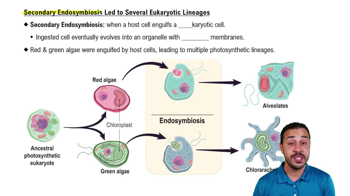
Explore secondary endosymbiosis: Secondary endosymbiosis occurs when a eukaryotic cell engulfs another eukaryotic cell that already contains plastids, leading to plastids with more than two membranes.
Analyze the options: Consider each option in the context of plastids with more than two membranes. Evolution from mitochondria (a) is unlikely as mitochondria are distinct organelles. Fusion of plastids (b) does not typically result in additional membranes. Origin from archaea (c) is not supported by current evidence.
Conclude with secondary endosymbiosis: The presence of more than two membranes around plastids is indicative of secondary endosymbiosis, where additional membranes are acquired during the engulfment process.

Verified video answer for a similar problem:

This video solution was recommended by our tutors as helpful for the problem above.
Video duration:
1m
Was this helpful?

Key Concepts

Here are the essential concepts you must grasp in order to answer the question correctly.

Plastids

Plastids are organelles found in the cells of plants and algae, primarily involved in photosynthesis and storage. They include chloroplasts, chromoplasts, and leucoplasts, each serving different functions. Plastids are typically surrounded by two membranes, but variations exist due to evolutionary processes.
Recommended video:
Guided course
07:56
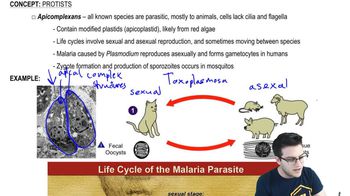
Apicomplexans

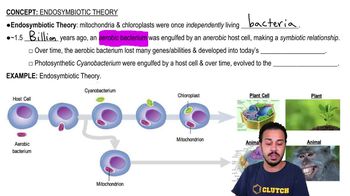
Endosymbiosis

Endosymbiosis is a theory explaining the origin of certain organelles, like mitochondria and plastids, through a symbiotic relationship where one organism lives inside another. Primary endosymbiosis involves the engulfment of a prokaryote, while secondary endosymbiosis involves a eukaryotic cell engulfing another eukaryotic cell, leading to organelles with more than two membranes.
Recommended video:
Guided course
06:58
Endosymbiotic Theory

Secondary Endosymbiosis

Secondary endosymbiosis occurs when a eukaryotic cell engulfs another eukaryotic cell that already contains plastids, resulting in plastids surrounded by more than two membranes. This process is a key evolutionary step in the diversification of algae and explains the complex membrane structures found in some plastids.
Recommended video:
Guided course
02:37
Secondary Endosymbiosis Led to Several Eukaryotic Lineages