
Textbook Question
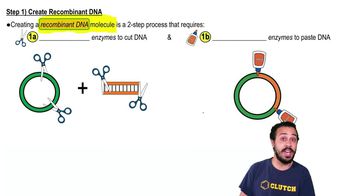
In DNA technology, the term vector can refer to
a. The enzyme that cuts DNA into restriction fragments.
b. The sticky end of a DNA fragment.
c. A SNP marker.
d. A plasmid used to transfer DNA into a living cell.


 Verified step by step guidance
 07:58
07:58
 02:09
02:09 04:16
04:16In DNA technology, the term vector can refer to
a. The enzyme that cuts DNA into restriction fragments.
b. The sticky end of a DNA fragment.
c. A SNP marker.
d. A plasmid used to transfer DNA into a living cell.
Plants are more readily manipulated by genetic engineering than are animals because
a. Plant genes do not contain introns.
b. More vectors are available for transferring recombinant DNA into plant cells.
c. A somatic plant cell can often give rise to a complete plant.
d. Plant cells have larger nuclei.
A paleontologist has recovered a bit of tissue from the 400-year-old preserved skin of an extinct dodo (a bird). To compare a specific region of the DNA from a sample with DNA from living birds, which of the following would be most useful for increasing the amount of dodo DNA available for testing?
a. SNP analysis
b. Polymerase chain reaction (PCR)
c. Electroporation
d. Gel electrophoresis
DNA technology has many medical applications. Which of the following is not done routinely at present?
a. Production of hormones for treating diabetes and dwarfism
b. Analysis of gene expression for more informed cancer treatments
c. Gene editing by the CRISPR-Cas9 system in viable human embryos to correct genetic diseases
d. Prenatal identification of genetic disease alleles