
Pearson+ LogoPearson+ Logo
Ch. 16 - The Molecular Basis of Inheritance
Campbell - Campbell Biology 11th Edition
Urry11th EditionCampbell BiologyISBN: 9789357423311Not the one you use?Change textbook
Chapter 16, Problem 2

What is the basis for the difference in how the leading and lagging strands of DNA molecules are synthesized?
a. The origins of replication occur only at the 5′ end.
b. Helicases and single-strand binding proteins work at the 5′ end.
c. DNA polymerase can join new nucleotides only to the 3′ end of a pre-existing strand, and the strands are antiparallel.
d. DNA ligase works only in the 3′→5′ direction.

Verified step by step guidance
1
Understand the structure of DNA: DNA is composed of two strands that are antiparallel, meaning one strand runs in the 5′ to 3′ direction and the other runs in the 3′ to 5′ direction.
Recognize the role of DNA polymerase: DNA polymerase is the enzyme responsible for synthesizing new DNA strands. It can only add nucleotides to the 3′ end of a pre-existing strand, which is crucial for understanding the synthesis of leading and lagging strands.
Identify the leading strand synthesis: The leading strand is synthesized continuously in the 5′ to 3′ direction as the DNA polymerase moves along the template strand, which is oriented in the 3′ to 5′ direction.
Identify the lagging strand synthesis: The lagging strand is synthesized discontinuously in short segments called Okazaki fragments. These fragments are synthesized in the 5′ to 3′ direction but require multiple starting points because the template strand runs in the 5′ to 3′ direction.
Understand the role of DNA ligase: DNA ligase is responsible for joining the Okazaki fragments on the lagging strand, creating a continuous DNA strand.

Verified video answer for a similar problem:

This video solution was recommended by our tutors as helpful for the problem above.
Video duration:
1m
Was this helpful?

Key Concepts

Here are the essential concepts you must grasp in order to answer the question correctly.

DNA Polymerase Directionality

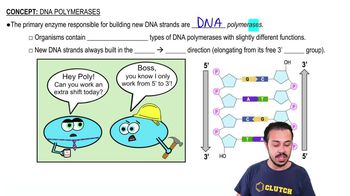
DNA polymerase is an enzyme that synthesizes DNA molecules by adding nucleotides to a pre-existing chain. It can only add new nucleotides to the 3' end of a DNA strand, which means it synthesizes DNA in a 5' to 3' direction. This directionality is crucial for understanding why the leading and lagging strands are synthesized differently during DNA replication.
Recommended video:
Guided course
04:01
DNA Polymerases

Antiparallel Strands

DNA strands are antiparallel, meaning they run in opposite directions. One strand runs 5' to 3', while the complementary strand runs 3' to 5'. This orientation is essential for DNA replication because it dictates how enzymes like DNA polymerase interact with the strands, leading to the continuous synthesis of the leading strand and the discontinuous synthesis of the lagging strand.
Recommended video:
Guided course
05:15
Leading & Lagging DNA Strands

Leading and Lagging Strand Synthesis

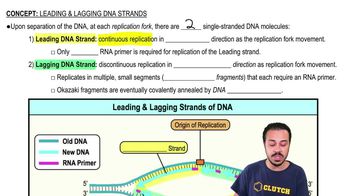
During DNA replication, the leading strand is synthesized continuously in the direction of the replication fork movement, while the lagging strand is synthesized discontinuously in short segments called Okazaki fragments. This difference arises because DNA polymerase can only add nucleotides to the 3' end, necessitating a backstitching mechanism for the lagging strand to accommodate the antiparallel nature of DNA.
Recommended video:
Guided course
05:15
Leading & Lagging DNA Strands