Pearson+ LogoPearson+ Logo
Ch. 13 - Meiosis and Sexual Life Cycles
Campbell - Campbell Biology 11th Edition
Urry11th EditionCampbell BiologyISBN: 9789357423311Not the one you use?Change textbook
Chapter 13, Problem 6c

The following diagram shows a cell in meiosis. Identify the stage of meiosis shown.
Diagram illustrating chromosomes during Meiosis I, showing homologous pairs and crossing over.

Verified step by step guidance
1
Observe the diagram: It shows two homologous chromosomes, each consisting of two sister chromatids, aligning closely together.
Notice the exchange of genetic material between the chromatids of homologous chromosomes, which is indicative of crossing over.
Crossing over occurs during the prophase I stage of meiosis, where homologous chromosomes pair up and exchange segments.
The presence of chiasmata, the points where crossing over occurs, is a key feature of prophase I.
Conclude that the stage of meiosis shown in the diagram is prophase I, characterized by synapsis and crossing over.

Verified video answer for a similar problem:

This video solution was recommended by our tutors as helpful for the problem above.
Video duration:
2m
Was this helpful?

Key Concepts

Here are the essential concepts you must grasp in order to answer the question correctly.

Meiosis

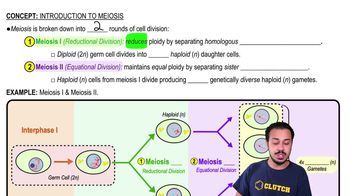
Meiosis is a type of cell division that reduces the chromosome number by half, resulting in four haploid cells. It consists of two consecutive divisions: meiosis I and meiosis II. This process is crucial for sexual reproduction, as it ensures genetic diversity through recombination and independent assortment of chromosomes.
Recommended video:
Guided course
04:49
Meiosis I & Meiosis II

Crossing Over

Crossing over is a process during prophase I of meiosis where homologous chromosomes exchange genetic material. This occurs at points called chiasmata and results in new combinations of alleles, contributing to genetic variation in gametes. The image shows chromosomes undergoing crossing over, indicating the stage is prophase I.
Recommended video:
Guided course
02:05
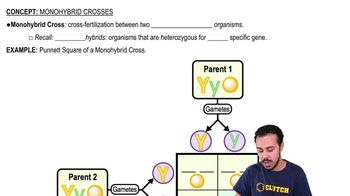
Monohybrid Crosses

Homologous Chromosomes

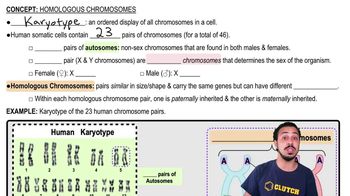
Homologous chromosomes are pairs of chromosomes, one from each parent, that are similar in shape, size, and genetic content. During meiosis, these pairs align and can undergo crossing over, as seen in the image. Understanding their behavior is essential for identifying stages of meiosis and the genetic outcomes of cell division.
Recommended video:
Guided course
08:09
Homologous Chromosomes
Related Practice
Textbook Question

If we continue to follow the cell lineage from question 4, then the DNA content of a single cell at metaphase of meiosis II will be

a. 0.25x

b. 0.5x

c. x.

d. 2x

1
views

Textbook Question

The diagram shows a cell in meiosis. Label the appropriate structures with these terms: chromosome (label as duplicated or unduplicated), centromere, kinetochore, sister chromatids, nonsister chromatids, homologous pair (use a bracket when labeling), homolog (label each one), chiasma, sister chromatid cohesion, and gene loci, labeling the alleles of the F and H genes.

Textbook Question

The diagram shows a cell in meiosis. Describe the makeup of a haploid set and a diploid set.

3
views
Textbook Question

Assume that genes A and B are on the same chromosome and are 50 map units apart. An animal heterozygous at both loci is crossed with one that is homozygous recessive at both loci. What percentage of the offspring will show recombinant phenotypes resulting from crossovers? Without knowing these genes are on the same chromosome, how would you interpret the results of this cross?

Textbook Question

Two genes of a flower, one controlling blue (B) versus white (b) petals and the other controlling round (R) versus oval (r) stamens, are linked and are 10 map units apart. You cross a homozygous blue oval plant with a homozygous white round plant. The resulting F1 progeny are crossed with homozygous white oval plants, and 1,000 offspring plants are obtained. How many plants of each of the four phenotypes do you expect?