
Textbook Question
If the DNA content of a diploid cell in the G1 phase of the cell cycle is x, then the DNA content of the same cell at metaphase of meiosis I will be
a. 0.25x
b. 0.5x
c. x
d. 2x
 Verified step by step guidance
 04:49
04:49
 04:14 04:14
If the DNA content of a diploid cell in the G1 phase of the cell cycle is x, then the DNA content of the same cell at metaphase of meiosis I will be
a. 0.25x
b. 0.5x
c. x
d. 2x
If we continue to follow the cell lineage from question 4, then the DNA content of a single cell at metaphase of meiosis II will be
a. 0.25x
b. 0.5x
c. x.
d. 2x
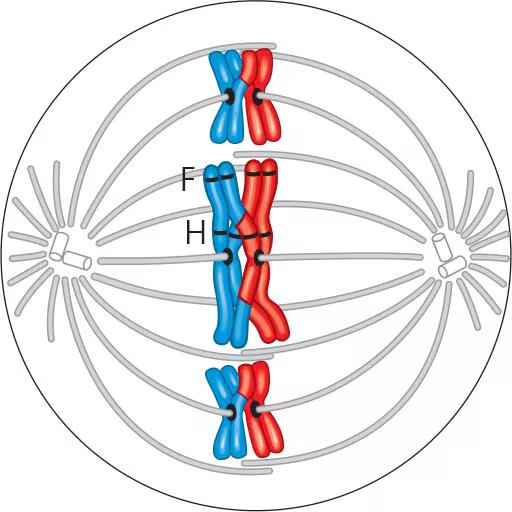
The diagram shows a cell in meiosis. Label the appropriate structures with these terms: chromosome (label as duplicated or unduplicated), centromere, kinetochore, sister chromatids, nonsister chromatids, homologous pair (use a bracket when labeling), homolog (label each one), chiasma, sister chromatid cohesion, and gene loci, labeling the alleles of the F and H genes.
The following diagram shows a cell in meiosis. Identify the stage of meiosis shown.
Assume that genes A and B are on the same chromosome and are 50 map units apart. An animal heterozygous at both loci is crossed with one that is homozygous recessive at both loci. What percentage of the offspring will show recombinant phenotypes resulting from crossovers? Without knowing these genes are on the same chromosome, how would you interpret the results of this cross?
Two genes of a flower, one controlling blue (B) versus white (b) petals and the other controlling round (R) versus oval (r) stamens, are linked and are 10 map units apart. You cross a homozygous blue oval plant with a homozygous white round plant. The resulting F1 progeny are crossed with homozygous white oval plants, and 1,000 offspring plants are obtained. How many plants of each of the four phenotypes do you expect?