
Textbook Question
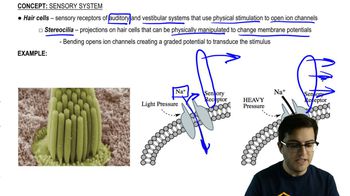
The middle ear converts
a. Air pressure waves to fluid pressure waves
b. Air pressure waves to nerve impulses
c. Fluid pressure waves to nerve impulses
d. Pressure waves to hair cell movements


 Verified step by step guidance
 04:19
04:19
 06:04
06:04 06:10
06:10The middle ear converts
a. Air pressure waves to fluid pressure waves
b. Air pressure waves to nerve impulses
c. Fluid pressure waves to nerve impulses
d. Pressure waves to hair cell movements
During the contraction of a vertebrate skeletal muscle fiber, calcium ions
a. Break cross-bridges as a cofactor in hydrolysis of ATP
b. Bind with troponin, changing its shape so that the myosin-binding sites on actin are exposed
c. Transmit action potentials from the motor neuron to the muscle fiber
d. Spread action potentials through the T tubules
The human brain differentiates tastes from smells because action potentials for the two sensations differ in
a. Magnitude and shape.
b. Threshold potential.
c. Where they are received in the brain.
d. How long they take to reach the brain.