
Pearson+ LogoPearson+ Logo
Ch. 48 - Neurons, Synapses, and Signaling
Campbell - Campbell Biology 12th Edition
Urry12th EditionCampbell BiologyISBN: 9785794169850Not the one you use?Change textbook
Chapter 48, Problem 3

Where are neurotransmitter receptors located?
a. The nuclear membrane
b. The nodes of Ranvier
c. The postsynaptic membrane
d. Synaptic vesicle membranes

Verified step by step guidance
1
Understand the role of neurotransmitter receptors: They are proteins that receive chemical signals from neurotransmitters released by neurons.
Identify the location where neurotransmitters are released: Neurotransmitters are released into the synaptic cleft, the space between neurons.
Determine where neurotransmitters bind after release: Neurotransmitters bind to receptors on the postsynaptic membrane, which is the membrane of the neuron receiving the signal.
Eliminate incorrect options: The nuclear membrane is not involved in neurotransmitter signaling, nodes of Ranvier are gaps in the myelin sheath of axons, and synaptic vesicle membranes are where neurotransmitters are stored before release.
Conclude that neurotransmitter receptors are located on the postsynaptic membrane, which is the correct answer.

Verified video answer for a similar problem:

This video solution was recommended by our tutors as helpful for the problem above.
Video duration:
47s
Was this helpful?

Key Concepts

Here are the essential concepts you must grasp in order to answer the question correctly.

Neurotransmitter Receptors

Neurotransmitter receptors are specialized protein molecules located on the surface of neurons. They bind to neurotransmitters released from the presynaptic neuron, facilitating the transmission of signals across synapses. These receptors are crucial for the communication between neurons and play a key role in the nervous system's function.
Recommended video:
Guided course
02:28
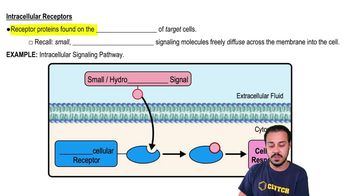
Intracellular Receptors

Postsynaptic Membrane

The postsynaptic membrane is the part of the neuron that receives signals from the presynaptic neuron. It is located on the dendrites or cell body of the neuron and contains neurotransmitter receptors. When neurotransmitters bind to these receptors, they trigger a response in the postsynaptic neuron, continuing the transmission of the neural signal.
Recommended video:
Guided course
05:33
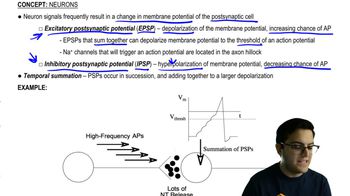
Postsynaptic Potentials and Summation

Synaptic Transmission

Synaptic transmission is the process by which neurons communicate with each other. It involves the release of neurotransmitters from the presynaptic neuron into the synaptic cleft, where they bind to receptors on the postsynaptic membrane. This binding initiates a response in the postsynaptic neuron, allowing the signal to be propagated through the nervous system.
Recommended video:
Guided course
02:50
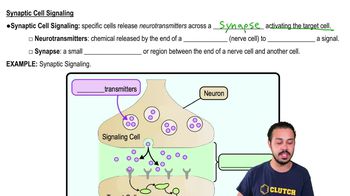
Synaptic Cell Signaling
Related Practice
Textbook Question

What happens when a resting neuron's membrane depolarizes?

a. There is a net diffusion of Na⁺ out of the cell

b. The equilibrium potential for K⁺ (Eₖ) becomes more positive

c. The neuron's membrane voltage becomes more positive

d. The cell's inside is more negative than the outside

1
views
Textbook Question

A common feature of action potentials is that they

a. Cause the membrane to hyperpolarize and then depolarize

b. Can undergo temporal and spatial summation

c. Are triggered by a depolarization that reaches threshold

d. Move at the same speed along all axons

Textbook Question

Why are action potentials usually conducted in one direction?

a. Ions can flow along the axon in only one direction

b. The brief refractory period prevents the reopening of voltage-gated Na⁺ channels

c. The axon hillock has a higher membrane potential than the terminals of the axon

d. Voltage-gated channels for both Na⁺ and K⁺ open in only one direction.

Textbook Question

Which of the following is the most direct result of depolarizing the presynaptic membrane of an axon terminal?

a. Voltage-gated calcium channels in the membrane open

b. Synaptic vesicles fuse with the membrane

c. Ligand-gated channels open, allowing neurotransmitters to enter the synaptic cleft

d. An EPSP or IPSP is generated in the postsynaptic cell

Textbook Question

Suppose a particular neurotransmitter causes an IPSP in postsynaptic cell X and an EPSP in postsynaptic cell Y. A likely explanation is that

a. The threshold value in the postsynaptic membrane is different for cell X and cell Y

b. The axon of cell X is myelinated, but that of cell Y is not

c. Only cell Y produces an enzyme that terminates the activity of the neurotransmitter

d. Cells X and Y express different receptor molecules for this particular neurotransmitter