Pearson+ LogoPearson+ Logo
Ch. 42 - Circulation and Gas Exchange
Campbell - Campbell Biology 12th Edition
Urry12th EditionCampbell BiologyISBN: 9785794169850Not the one you use?Change textbook
Chapter 42, Problem 1

Which of the following respiratory systems is not closely associated with a blood supply?
a. The lungs of a vertebrate
b. The gills of a fish
c. The tracheal system of an insect
d. The skin of an earthworm

Verified step by step guidance
1
Identify the function of a respiratory system: to facilitate the exchange of gases (oxygen and carbon dioxide) between the organism and its environment.
Understand that most respiratory systems are closely associated with a blood supply to transport gases to and from cells. For example, vertebrate lungs and fish gills are connected to a circulatory system that carries oxygen to the body and removes carbon dioxide.
Consider the tracheal system of an insect: it consists of a network of tubes that directly deliver oxygen to tissues and cells without the need for a circulatory system to transport gases.
Recognize that the skin of an earthworm is a respiratory surface that is associated with a blood supply, as earthworms use their skin to exchange gases directly with the environment, and their circulatory system helps distribute these gases.
Conclude that the tracheal system of an insect is the respiratory system not closely associated with a blood supply, as it directly delivers gases to tissues without the need for blood transport.

Verified video answer for a similar problem:

This video solution was recommended by our tutors as helpful for the problem above.
Video duration:
1m
Was this helpful?

Key Concepts

Here are the essential concepts you must grasp in order to answer the question correctly.

Respiratory Systems

Respiratory systems are biological structures that facilitate gas exchange, primarily oxygen and carbon dioxide, between an organism and its environment. Different organisms have evolved various respiratory systems, such as lungs, gills, tracheal systems, and skin, to efficiently meet their metabolic needs. Each system is adapted to the organism's habitat and lifestyle.
Recommended video:
Guided course
02:15
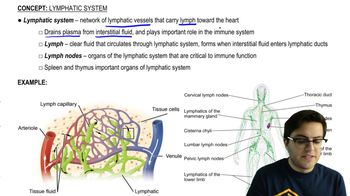
Lymphatic System

Tracheal System of Insects

The tracheal system in insects is a network of air-filled tubes that directly deliver oxygen to tissues and cells, bypassing the need for a circulatory system to transport gases. Air enters through spiracles and diffuses through the tracheae and tracheoles, allowing for efficient gas exchange without the involvement of blood. This system is highly effective for small, terrestrial organisms like insects.
Recommended video:
Guided course
09:19
Immune System

Association with Blood Supply

In many organisms, respiratory systems are closely linked with the circulatory system to transport gases throughout the body. For example, vertebrate lungs and fish gills are richly supplied with blood vessels to facilitate the exchange of gases between the respiratory surface and the bloodstream. However, some systems, like the insect tracheal system, operate independently of the blood supply.
Recommended video:
Guided course
07:01
Blood Sugar Homeostasis