Pearson+ LogoPearson+ Logo
Ch. 41 - Animal Nutrition
Campbell - Campbell Biology 12th Edition
Urry12th EditionCampbell BiologyISBN: 9785794169850Not the one you use?Change textbook
Chapter 41, Problem 4

In which digestive system organ does nearly all nutrient absorption occur?
a. Stomach
b. Small intestine
c. Large intestine
d. Pancreas

Verified step by step guidance
1
Understand the function of each organ listed in the options: The stomach primarily breaks down food using acids and enzymes, the small intestine is where most digestion and absorption of nutrients occur, the large intestine absorbs water and forms feces, and the pancreas produces enzymes and hormones for digestion.
Recall that nutrient absorption involves the transfer of nutrients from the digestive tract into the bloodstream.
Consider the structure of the small intestine: It has a large surface area due to villi and microvilli, which are specialized for maximizing nutrient absorption.
Compare the roles of the small intestine and the other organs: The small intestine is specifically adapted for absorbing nutrients, unlike the stomach, large intestine, or pancreas.
Conclude that the small intestine is the organ where nearly all nutrient absorption occurs, based on its structure and function.

Verified video answer for a similar problem:

This video solution was recommended by our tutors as helpful for the problem above.
Video duration:
40s
Was this helpful?

Key Concepts

Here are the essential concepts you must grasp in order to answer the question correctly.

Digestive System

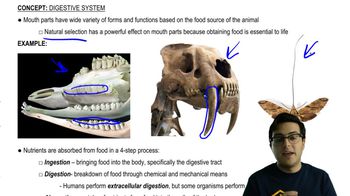
The digestive system is a complex series of organs and glands that processes food. It involves the breakdown of food into nutrients, which the body uses for energy, growth, and cell repair. Key organs include the stomach, small intestine, large intestine, and pancreas, each playing specific roles in digestion and absorption.
Recommended video:
Guided course
05:11
Digestion and Digestive Tracts

Nutrient Absorption

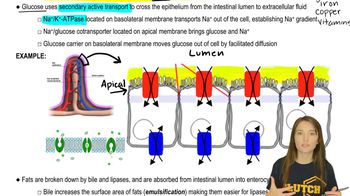
Nutrient absorption is the process by which digested food particles are taken up by the cells lining the digestive tract. This primarily occurs in the small intestine, where nutrients like carbohydrates, proteins, fats, vitamins, and minerals are absorbed into the bloodstream to be distributed throughout the body.
Recommended video:
Guided course
19:59
Nutrient Absorption

Small Intestine

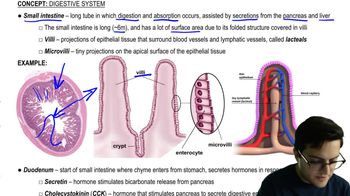
The small intestine is a long, coiled organ where most digestion and nutrient absorption occur. It consists of three parts: the duodenum, jejunum, and ileum. The inner surface is lined with villi and microvilli, which increase the surface area for absorption, making it the primary site for nutrient uptake.
Recommended video:
Guided course
06:15
Small Intestine and Pancreas