Pearson+ LogoPearson+ Logo
Ch. 39 - Plant Responses to Internal and External Signals
Campbell - Campbell Biology 12th Edition
Urry12th EditionCampbell BiologyISBN: 9785794169850Not the one you use?Change textbook
Chapter 39, Problem 6

If a long-day plant has a critical night length of 9 hours, which 24-hour cycle would prevent flowering?
a. 16 hours light/8 hours dark
b. 14 hours light/10 hours dark
c. 4 hours light/8 hours dark/4 hours light/8 hours dark
d. 8 hours light/8 hours dark/light flash/8 hours dark

Verified step by step guidance
1
Understand the concept of critical night length: Long-day plants require a night shorter than their critical night length to initiate flowering. In this case, the critical night length is 9 hours.
Evaluate option a (16 hours light/8 hours dark): The dark period is 8 hours, which is shorter than the critical night length of 9 hours, allowing flowering.
Evaluate option b (14 hours light/10 hours dark): The dark period is 10 hours, which is longer than the critical night length of 9 hours, preventing flowering.
Evaluate option c (4 hours light/8 hours dark/4 hours light/8 hours dark): The longest continuous dark period is 8 hours, which is shorter than the critical night length, allowing flowering.
Evaluate option d (8 hours light/8 hours dark/light flash/8 hours dark): The light flash interrupts the dark period, making the longest continuous dark period less than 9 hours, allowing flowering.

Verified video answer for a similar problem:

This video solution was recommended by our tutors as helpful for the problem above.
Video duration:
3m
Was this helpful?

Key Concepts

Here are the essential concepts you must grasp in order to answer the question correctly.

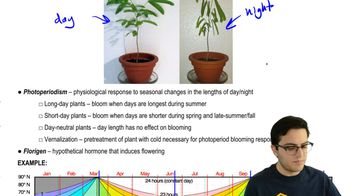
Photoperiodism

Photoperiodism is the physiological reaction of organisms to the length of day or night. In plants, it affects flowering and other developmental processes. Long-day plants require a light period longer than a critical length to flower, meaning they need shorter nights. Understanding photoperiodism is crucial for determining how different light/dark cycles influence plant behavior.
Recommended video:
Guided course
04:34
Photoderiodism

Critical Night Length

Critical night length is the minimum duration of uninterrupted darkness required for a plant to either initiate or inhibit flowering. For long-day plants, flowering is triggered when the night is shorter than this critical length. In the given question, a night longer than 9 hours would prevent flowering, as it exceeds the plant's critical night length.
Recommended video:
03:54
Interpreting Branch Length

Interruption of Dark Period

Interruption of the dark period can affect a plant's perception of night length. A brief light exposure during the night can reset the plant's internal clock, making it perceive the night as shorter. This is particularly relevant for long-day plants, where a light flash during the night can prevent the plant from recognizing a long night, thus promoting flowering.
Recommended video:
03:23
Gradual Evolution vs. Punctuated Equilibrium