Pearson+ LogoPearson+ Logo
Ch. 29 - Plant Diversity I: How Plants Colonized Land
Campbell - Campbell Biology 12th Edition
Urry12th EditionCampbell BiologyISBN: 9785794169850Not the one you use?Change textbook
Chapter 29, Problem 3

In angiosperms, which of the following is correctly paired with its chromosome count?
a. Microspore—n
b. Zygote—n
c. Egg—2n
d. Megaspore—2n

Verified step by step guidance
1
Understand the life cycle of angiosperms, which includes alternation of generations between a diploid sporophyte and a haploid gametophyte.
Recall that in angiosperms, the microspore is a haploid cell (n) that develops into the male gametophyte or pollen grain.
Recognize that the zygote is formed by the fusion of two haploid gametes (egg and sperm), resulting in a diploid cell (2n).
Remember that the egg cell is a haploid cell (n) produced by the female gametophyte.
Identify that the megaspore is a haploid cell (n) that develops into the female gametophyte, not diploid (2n).

Verified video answer for a similar problem:

This video solution was recommended by our tutors as helpful for the problem above.
Video duration:
1m
Was this helpful?

Key Concepts

Here are the essential concepts you must grasp in order to answer the question correctly.

Chromosome Count in Angiosperms

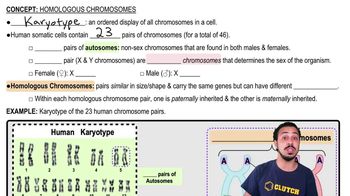
In angiosperms, the chromosome count varies between different stages of the plant's reproductive cycle. Haploid cells, denoted as 'n', contain a single set of chromosomes, while diploid cells, denoted as '2n', contain two sets. Understanding which cells are haploid or diploid is crucial for determining the correct chromosome count in various reproductive structures.
Recommended video:
Guided course
08:09
Homologous Chromosomes

Microspore and Megaspore Development

Microspores and megaspores are part of the plant's reproductive process. Microspores are haploid (n) and develop into male gametophytes, while megaspores are also haploid (n) and develop into female gametophytes. These spores are produced through meiosis, which reduces the chromosome number from diploid to haploid.
Recommended video:
Guided course
06:02
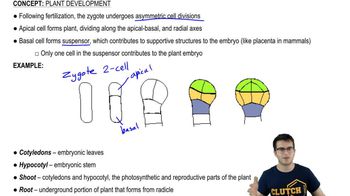
Embryonic Plant Development

Zygote Formation in Angiosperms

A zygote is formed when two haploid gametes, an egg and a sperm, fuse during fertilization. This fusion results in a diploid cell (2n), which will develop into a new organism. Understanding the transition from haploid gametes to a diploid zygote is essential for comprehending the reproductive cycle of angiosperms.
Recommended video:
Guided course
03:08
Formation & Breakdown of Polysaccharides