Pearson+ LogoPearson+ Logo
Ch. 25 - The History of Life on Earth
Campbell - Campbell Biology 12th Edition
Urry12th EditionCampbell BiologyISBN: 9785794169850Not the one you use?Change textbook
Chapter 25, Problem 6

A genetic change that caused a certain Hox gene to be expressed along the tip of a vertebrate limb bud instead of farther back helped make possible the evolution of the tetrapod limb. This type of change is illustrative of
a. The influence of environment on development.
b. Paedomorphosis.
c. A change in a developmental gene or in its regulation that altered the spatial organization of body parts.
d. Heterochrony.

Verified step by step guidance
1
Understand the role of Hox genes: Hox genes are a group of related genes that control the body plan of an embryo along the head-tail axis. They are crucial in determining the identity and positioning of body parts.
Identify the type of genetic change: The problem describes a change in the expression pattern of a Hox gene, which affects where the gene is active in the developing limb bud.
Consider the options: a) Influence of environment on development refers to external factors affecting growth, which is not the case here. b) Paedomorphosis involves retention of juvenile features in the adult organism, which is unrelated to the spatial expression of genes. c) A change in a developmental gene or its regulation that altered the spatial organization of body parts directly describes the scenario. d) Heterochrony involves changes in the timing of developmental events, not spatial changes.
Focus on spatial organization: The key aspect of the problem is the change in spatial expression of the Hox gene, which aligns with option c.
Conclude with the most fitting explanation: The genetic change described is best explained by a change in a developmental gene or its regulation that altered the spatial organization of body parts, making option c the correct choice.

Verified video answer for a similar problem:

This video solution was recommended by our tutors as helpful for the problem above.
Video duration:
1m
Was this helpful?

Key Concepts

Here are the essential concepts you must grasp in order to answer the question correctly.

Hox Genes

Hox genes are a group of related genes that control the body plan of an embryo along the head-tail axis. They are crucial in determining the identity and arrangement of body segments in animals. Changes in the expression of Hox genes can lead to significant evolutionary transformations, such as the development of limbs in tetrapods.
Recommended video:

Developmental Gene Regulation

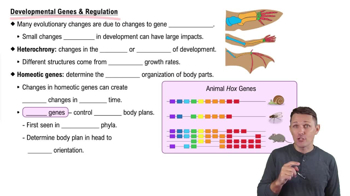
Developmental gene regulation involves the control of gene expression patterns during the development of an organism. This regulation can affect when, where, and how genes are expressed, influencing the spatial organization of body parts. Alterations in this regulation can lead to evolutionary changes, as seen in the expression of Hox genes in limb development.
Recommended video:
06:12
Developmental Genes & Regulation

Spatial Organization of Body Parts

The spatial organization of body parts refers to the arrangement and positioning of tissues and organs in an organism. This organization is crucial for proper function and is determined by genetic and developmental processes. Changes in the spatial expression of genes, such as Hox genes, can lead to evolutionary adaptations, like the formation of tetrapod limbs from finned ancestors.
Recommended video:
Guided course
06:52
Organization of DNA in the Cell