Pearson+ LogoPearson+ Logo
Ch. 2 - The Chemical Context of Life
Campbell - Campbell Biology 12th Edition
Urry12th EditionCampbell BiologyISBN: 9785794169850Not the one you use?Change textbook
Chapter 2, Problem 5

Which of the following statements correctly describes any chemical reaction that has reached equilibrium?
a. The concentrations of products and reactants are equal.
b. The reaction is now irreversible.
c. Both forward and reverse reactions have halted.
d. The rates of the forward and reverse reactions are equal.

Verified step by step guidance
1
Understand the concept of chemical equilibrium: In a chemical reaction, equilibrium is reached when the rate of the forward reaction equals the rate of the reverse reaction.
Analyze statement (A): 'The concentrations of products and reactants are equal.' This is incorrect because equilibrium does not imply equal concentrations, but rather equal rates of the forward and reverse reactions.
Analyze statement (B): 'The reaction is now irreversible.' This is incorrect because at equilibrium, reactions are reversible, and both forward and reverse reactions continue to occur.
Analyze statement (C): 'Both forward and reverse reactions have halted.' This is incorrect because at equilibrium, both reactions continue to occur at equal rates, not halted.
Analyze statement (D): 'The rates of the forward and reverse reactions are equal.' This is correct because at equilibrium, the rates of the forward and reverse reactions are indeed equal, allowing the concentrations of reactants and products to remain constant.

Verified video answer for a similar problem:

This video solution was recommended by our tutors as helpful for the problem above.
Video duration:
1m
Was this helpful?

Key Concepts

Here are the essential concepts you must grasp in order to answer the question correctly.

Chemical Equilibrium

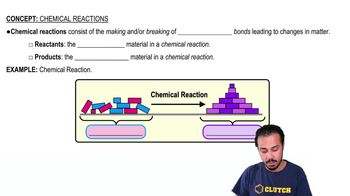
Chemical equilibrium occurs when the rate of the forward reaction equals the rate of the reverse reaction, resulting in no net change in the concentrations of reactants and products. It is a dynamic state where reactions continue to occur, but the overall concentrations remain constant.
Recommended video:
Guided course
01:56
Chemical Reactions

Reaction Rates

Reaction rates refer to the speed at which reactants are converted into products in a chemical reaction. At equilibrium, the rates of the forward and reverse reactions are equal, meaning that the processes are ongoing but balanced, maintaining constant concentrations of substances involved.
Recommended video:
Guided course
01:56
Chemical Reactions

Concentration of Reactants and Products

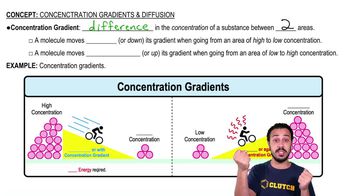
In a chemical reaction at equilibrium, the concentrations of reactants and products are not necessarily equal, but they remain constant over time. This stability is due to the equal rates of the forward and reverse reactions, allowing the system to maintain a steady state without further net change.
Recommended video:
Guided course
04:51
Concentration Gradients and Diffusion
Related Practice
Textbook Question

In the term trace element, the adjective trace means that

a. The element is required in very small amounts.

b. The element can be used as a label to trace atoms through an organism's metabolism.

c. The element is very rare on Earth.

d. The element enhances health but is not essential for the organism's long-term survival.

24
views
Textbook Question

The reactivity of an atom arises from

a. The average distance of the outermost electron shell from the nucleus.

b. The existence of unpaired electrons in the valence shell.

c. The sum of the potential energies of all the electron shells.

d. The potential energy of the valence shell.

18
views
Textbook Question

Which statement is true of all atoms that are anions?

a. The atom has more electrons than protons.

b. The atom has more protons than electrons.

c. The atom has fewer protons than does a neutral atom of the same element.

d. The atom has more neutrons than protons.

12
views
Textbook Question

We can represent atoms by listing the number of protons, neutrons, and electrons—for example, 2p+, 2p+,2n0,2e− for helium. Which of the following represents the 18O isotope of oxygen?

a. 7p+, 2n0, 9e−

b. 8p+, 10n0, 8e−

c. 9p+, 9n0, 9e−

d. 10p+, 8n0, 9e-

23
views
1
rank
Textbook Question

The atomic number of sulfur is 16. Sulfur combines with hydrogen by covalent bonding to form a compound, hydrogen sulfide. Based on the number of valence electrons in a sulfur atom, predict the molecular formula of the compound.

a. HS

b. HS2

c. H2S

d. H4S

3
views
Textbook Question

What coefficients must be placed in the following blanks so that all atoms are accounted for in the products?

C6H12O6 → _____C2H6O + _____CO2

a. 2; 1

b. 3; 1

c. 1; 3

d. 2; 2

2
views