Pearson+ LogoPearson+ Logo
Ch. 19 - Viruses
Campbell - Campbell Biology 12th Edition
Urry12th EditionCampbell BiologyISBN: 9785794169850Not the one you use?Change textbook
Chapter 19, Problem 4

A bacterium is infected with an experimentally constructed bacteriophage composed of the T2 phage protein coat and T4 phage DNA. The new phages produced would have
a. T2 protein and T4 DNA.
b. T4 protein and T2 DNA.
c. T2 protein and T2 DNA.
d. T4 protein and T4 DNA.

Verified step by step guidance
1
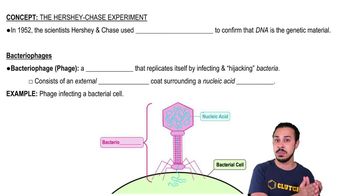
Understand the structure of bacteriophages: Bacteriophages consist of a protein coat and genetic material, which can be either DNA or RNA. The protein coat protects the genetic material and facilitates the infection of host cells.
Identify the components involved in the problem: The bacterium is infected with a bacteriophage that has a T2 phage protein coat and T4 phage DNA. This means the protein coat is from the T2 phage, while the genetic material is from the T4 phage.
Consider the replication process of bacteriophages: When a bacteriophage infects a bacterium, it injects its genetic material into the host cell. The host cell's machinery is then used to replicate the phage's DNA and produce new phage particles.
Determine the outcome of the infection: Since the genetic material (DNA) dictates the characteristics of the new phages, the new phages produced will have the DNA of the T4 phage. The protein coat of the new phages will be determined by the genetic instructions provided by the T4 DNA.
Conclude the characteristics of the new phages: The new phages produced will have T4 protein and T4 DNA, as the DNA from the T4 phage will direct the synthesis of both the protein coat and the genetic material.

Verified video answer for a similar problem:

This video solution was recommended by our tutors as helpful for the problem above.
Video duration:
58s
Was this helpful?

Key Concepts

Here are the essential concepts you must grasp in order to answer the question correctly.

Bacteriophage Structure

Bacteriophages are viruses that infect bacteria, consisting of a protein coat (capsid) and genetic material, either DNA or RNA. The protein coat protects the genetic material and facilitates the infection of the host bacterium. Understanding the structure is crucial for determining how phages replicate and what components are passed on to progeny.
Recommended video:
Guided course
03:44
Bacteriophages

Genetic Material Replication

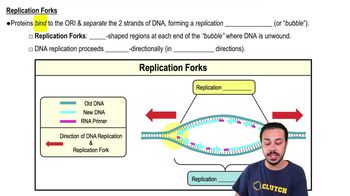
During the infection process, the genetic material of the bacteriophage is injected into the host bacterium, where it hijacks the host's cellular machinery to replicate its DNA and produce new phage components. The type of DNA present in the initial phage determines the genetic material of the progeny, as the host replicates the injected DNA.
Recommended video:
Guided course
04:
Replication Forks

Phage Assembly

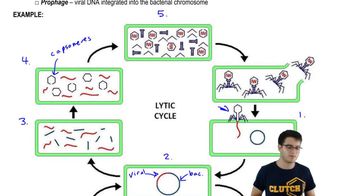
After replication, new phage particles are assembled within the host cell. The protein coat is synthesized based on the genetic instructions provided by the phage DNA. Therefore, the type of protein coat in the progeny phages is determined by the DNA of the infecting phage, not the protein coat of the original phage.
Recommended video:
Guided course
08:05
Lytic and Lysogenic Cycles