Pearson+ LogoPearson+ Logo
Ch. 18 - Regulation of Gene Expression
Campbell - Campbell Biology 12th Edition
Urry12th EditionCampbell BiologyISBN: 9785794169850Not the one you use?Change textbook
Chapter 18, Problem 10

Proto-oncogenes can change into oncogenes that cause cancer. Which of the following best explains the presence of these potential time bombs in eukaryotic cells?
a. Proto-oncogenes first arose from viral infections.
b. Proto-oncogenes are mutant versions of normal genes.
c. Proto-oncogenes are genetic 'junk'.
d. Proto-oncogenes normally help regulate cell division.

Verified step by step guidance
1
Understand the role of proto-oncogenes: Proto-oncogenes are normal genes that play a crucial role in regulating cell growth and division. They are essential for normal cellular functions and development.
Recognize the transformation process: Proto-oncogenes can become oncogenes through mutations or increased expression. This transformation can lead to uncontrolled cell division, contributing to cancer development.
Evaluate the options: Consider each option provided in the problem. Option a suggests a viral origin, which is not typically how proto-oncogenes arise. Option b implies they are mutant versions, which is incorrect as they are normal genes before mutation. Option c labels them as genetic 'junk,' which is misleading as they have important regulatory functions.
Focus on the correct explanation: Option d states that proto-oncogenes normally help regulate cell division, which aligns with their biological role. They are not inherently harmful but can become problematic if altered.
Conclude with the best choice: Based on the understanding of proto-oncogenes, option d is the most accurate explanation of their presence in eukaryotic cells, highlighting their role in normal cellular processes.

Verified video answer for a similar problem:

This video solution was recommended by our tutors as helpful for the problem above.
Video duration:
4m
Was this helpful?

Key Concepts

Here are the essential concepts you must grasp in order to answer the question correctly.

Proto-oncogenes

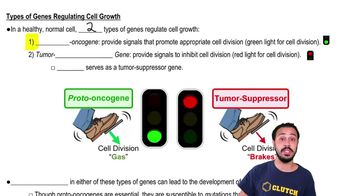
Proto-oncogenes are normal genes found in eukaryotic cells that play a crucial role in regulating cell growth and division. They encode proteins that help control the cell cycle, ensuring cells divide at the right time and maintain healthy tissue function. When mutated or abnormally expressed, proto-oncogenes can become oncogenes, leading to uncontrolled cell proliferation and cancer.
Recommended video:
Guided course
04:02
Types of Genes Regulating Cell Growth

Oncogenes

Oncogenes are mutated or overexpressed versions of proto-oncogenes that contribute to cancer development. These genes can lead to the production of proteins that drive excessive cell division, inhibit normal cell death, or promote other cancerous behaviors. Understanding oncogenes is crucial for developing targeted cancer therapies and understanding tumorigenesis.
Recommended video:
Guided course
04:02
Types of Genes Regulating Cell Growth

Cell Division Regulation

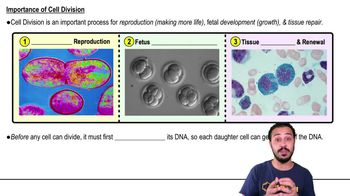
Cell division regulation is a fundamental biological process that ensures cells divide correctly and at appropriate times. It involves a complex network of signals and checkpoints that control the cell cycle, preventing errors that could lead to diseases like cancer. Proto-oncogenes are integral to this regulation, as they encode proteins that help manage these processes, highlighting their importance in maintaining cellular health.
Recommended video:
Guided course
03:19
Importance of Cell Division