Pearson+ LogoPearson+ Logo
Ch. 14 - Mendel and the Gene Idea
Campbell - Campbell Biology 12th Edition
Urry12th EditionCampbell BiologyISBN: 9785794169850Not the one you use?Change textbook
Chapter 14, Problem 12

In maize (corn) plants, a dominant allele I inhibits kernel color, while the recessive allele i permits color when homozygous. At a different locus, the dominant allele P causes purple kernel color, while the homozygous recessive genotype pp causes red kernels. If plants heterozygous at both loci are crossed, what will be the phenotypic ratio of the offspring?

Verified step by step guidance
1
Step 1: Understand the problem. The problem is asking for the phenotypic ratio of the offspring when maize plants that are heterozygous at both loci are crossed. The loci in question are for kernel color inhibition (I/i) and kernel color (P/p).
Step 2: Determine the genotypes of the parent plants. Since the plants are heterozygous at both loci, their genotypes are IiPp.
Step 3: Set up a dihybrid cross. A dihybrid cross is a breeding experiment between P generation (parental generation) organisms that differ in two traits. In this case, the two traits are kernel color inhibition and kernel color. The cross will be IiPp x IiPp.
Step 4: Determine the possible genotypes of the offspring. Using the rules of Mendelian genetics, we can determine that the possible genotypes are: IIPP, IIPp, IiPP, IiPp, IiPp, Iipp, iiPP, iiPp, iiPp, and iipp.
Step 5: Determine the phenotypes associated with each genotype. The dominant allele I inhibits color, so any genotype with at least one I will result in colorless kernels, regardless of the P/p genotype. The remaining genotypes (iiPP, iiPp, iiPp, and iipp) will result in colored kernels. The dominant allele P causes purple color, so iiPP and iiPp will result in purple kernels. The homozygous recessive genotype pp causes red kernels, so iipp will result in red kernels. Therefore, the phenotypic ratio of the offspring will be 12:3:1 (colorless:purple:red).

Verified video answer for a similar problem:

This video solution was recommended by our tutors as helpful for the problem above.
Video duration:
9m
Was this helpful?

Key Concepts

Here are the essential concepts you must grasp in order to answer the question correctly.

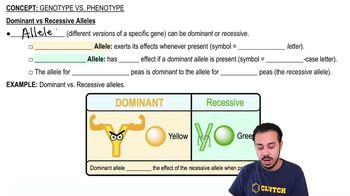
Dominant and Recessive Alleles

In genetics, alleles are different forms of a gene. A dominant allele, represented by a capital letter (e.g., I or P), masks the effect of a recessive allele (e.g., i or p) when both are present in a heterozygous individual. This means that the phenotype (observable traits) of the organism will reflect the dominant allele's characteristics.
Recommended video:
Guided course
03:39
Dominant vs. Recessive Alleles

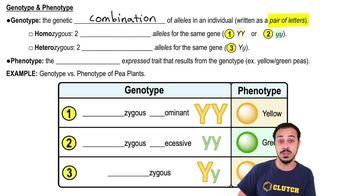
Homozygous and Heterozygous Genotypes

A homozygous genotype consists of two identical alleles for a particular gene (e.g., ii or pp), while a heterozygous genotype contains two different alleles (e.g., Ii or Pp). The expression of traits in offspring depends on the combination of these alleles inherited from the parents, influencing the resulting phenotypes.
Recommended video:
Guided course
06:36
Genotype & Phenotype

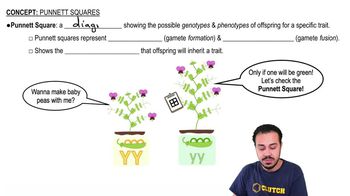
Punnett Square and Phenotypic Ratios

A Punnett square is a diagram used to predict the genetic outcomes of a cross between two organisms. By filling in the square with the possible gametes from each parent, one can determine the expected genotypes and phenotypes of the offspring. The phenotypic ratio is the relative number of offspring displaying each phenotype, which can be calculated from the results of the Punnett square.
Recommended video:
Guided course
01:37
Punnett Squares
Related Practice
Textbook Question

Karen and Steve each have a sibling with sickle-cell disease. Neither Karen nor Steve nor any of their parents have the disease, and none of them have been tested to see if they carry the sickle-cell allele. Based on this incomplete information, calculate the probability that if this couple has a child, the child will have sickle-cell disease.

Textbook Question

In 1981, a stray black cat with unusual rounded, curled-back ears was adopted by a family in California. Hundreds of descendants of the cat have since been born, and cat fanciers hope to develop the curl cat into a show breed. Suppose you owned the first curl cat and wanted to develop a true-breeding variety. How would you determine whether the curl allele is dominant or recessive? How would you obtain true-breeding curl cats? How could you be sure they are true-breeding?

<IMAGE>

Textbook Question

In tigers, a recessive allele of a particular gene causes both an absence of fur pigmentation (a white tiger) and a cross-eyed condition. If two phenotypically normal tigers that are heterozygous at this locus are mated, what percentage of their offspring will be cross-eyed? What percentage of cross-eyed tigers will be white?

Textbook Question

The pedigree below traces the inheritance of alkaptonuria, a biochemical disorder. Affected individuals, indicated here by the colored circles and squares, are unable to metabolize a substance called alkapton, which colors the urine and stains body tissues. Does alkaptonuria appear to be caused by a dominant allele or by a recessive allele? Fill in the genotypes of the individuals whose genotypes can be deduced. What genotypes are possible for each of the other individuals?

Textbook Question

Imagine that you are a genetic counselor, and a couple planning to start a family comes to you for information. Charles was married once before, and he and his first wife had a child with cystic fibrosis. The brother of his current wife, Elaine, died of cystic fibrosis. What is the probability that Charles and Elaine will have a baby with cystic fibrosis? (Neither Charles, Elaine, nor their parents have cystic fibrosis.)